

UV printing and thermal transfer printing can both produce durable graphics, labels, identification marks, and customized products, but their cost structures are very different.

The biggest mistake is comparing machine prices alone.A thermal transfer printer can cost only a fraction of a UV printer, but the finished job may require label stock, ribbon, cutting, application labor, inventory, or a separate transfer step. UV printing requires more capital and maintenance, but it can print full-color graphics directly onto a finished object and eliminate some of those intermediate materials and operations.
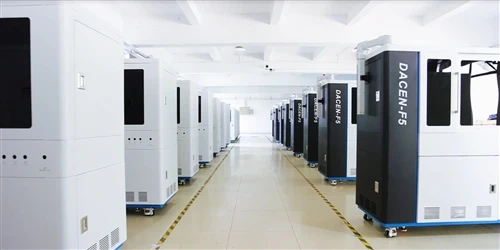
For buyers considering direct decoration of rigid products, Dacen's direct-to-object printing guide explains where UV printing fits compared with label- or transfer-based workflows.
Upfront and Capital Costs: UV vs Thermal Transfer
Thermal transfer normally has the lower entry cost.
As of October 2026, SATO's published U.S. pricing shows how relatively modest an industrial thermal-transfer investment can be. A CL4NX Plus is listed at approximately $2,370 for 203 dpi, $2,905 for 305 dpi, and $4,189 for 609 dpi. The larger CL6NX Plus is approximately $4,152–$4,746 depending on resolution.
UV equipment starts substantially higher.Epson currently lists its compact SureColor V1070 UV flatbed at $9,299. Mimaki lists the UJF-3042 MkII e at a $21,995 MSRP, with promotional pricing recently around $19,995. At the industrial end, Mimaki lists the JFX600-2513 at approximately $185,000 MSRP.
That produces a useful capital framework:
| Equipment Level | Thermal Transfer | UV Printing |
|---|---|---|
| Commercial / desktop | Hundreds to low thousands* | About $9,000–$22,000 |
| Industrial / production | About $2,000–$6,000+ for many label systems | $20,000–$100,000+ |
| High-volume industrial | Configuration-dependent | $100,000–$200,000+ |
*Actual thermal-transfer prices depend heavily on width, resolution, RFID, rewind and automation options.
A Dacen UV flatbed printer should therefore be evaluated as production equipment rather than simply compared with the purchase price of a label printer.
Depreciation changes the comparison
Suppose a shop buys a $20,000 UV printer and assumes a five-year accounting life with a 10% residual value.
Straight-line annual depreciation would be:
($20,000 − $2,000) ÷ 5 = $3,600 per year
A $4,000 thermal-transfer system under the same assumptions would depreciate approximately:
($4,000 − $400) ÷ 5 = $720 per year
These are accounting examples, not U.S. tax advice. Tax depreciation, Section 179 eligibility and bonus depreciation should be reviewed with an accountant under the rules applicable in the year of purchase.
Leasing can reduce the initial cash requirement. Roland, for example, currently publishes 60-month lease pricing on several UV systems; its MO-240 has recently been advertised at about $609 per month under promotional financing terms for qualified applicants.
Regional differences in the United States are more likely to appear in sales tax, freight, installation, technician travel and electricity costs than in the fundamental printer technology.
Per-Item Costs: Ink, Ribbon, Setup and Throughput
Per-item cost is where the comparison becomes more complicated.
Thermal transfer typically consumes:
label or film + ribbon + setup waste + cutting/rewinding + application labor
UV printing typically consumes:
UV ink + white ink/varnish if used + primer if required + cleaning allowance + fixture/loading labor
Dacen's current UV flatbed printer cost and ROI guide estimates UV ink alone at roughly $0.10–$0.60 per square foot for light-to-moderate coverage, before additional white ink and varnish.
The amount per item can therefore be very small on a compact product. A 3 × 4 in. image covers only about 0.083 ft². At that published ink-cost range, basic image ink would represent roughly $0.008–$0.05 before white, varnish, primer, cleaning, labor and scrap.
Thermal transfer can be even less expensive when the output is simply a monochrome barcode or identification label.

SATO publishes a useful real-world example from Athena Controls. The company reported that its previous labeling method cost approximately $0.20 per label, while its SATO thermal-transfer workflow reduced the figure to approximately $0.13 per label, while also helping avoid artwork and label-inventory costs.
That is why a UV printer should not be purchased to replace a $0.13 barcode label unless UV eliminates another expensive production step or creates more valuable output.
Modeled 100-, 1,000- and 10,000-piece comparison
Consider a hypothetical rigid product that can either be decorated directly by UV or receive a thermal-transfer printed label.
Assume:
UV: $15 job setup + $0.16 loaded variable cost per item
Thermal-transfer label: $5 setup + $0.09 label/ribbon cost
Manual application of thermal-transfer label: additional $0.10 per item
These are illustrative assumptions, not market averages.
| Quantity | UV Direct Print | TT Label Only | TT Label + Manual Application |
|---|---|---|---|
| 100 | $0.31/item | $0.14/item | $0.24/item |
| 1,000 | $0.175/item | $0.095/item | $0.195/item |
| 10,000 | $0.162/item | $0.091/item | $0.191/item |
The lesson is more important than the sample numbers.
At low volume, thermal transfer often wins because equipment and setup costs are low. As volume rises, UV can become attractive when direct printing eliminates label material, transfer film, application labor, cutting, mounting or inventory.
If all you need is a durable one-color barcode on polyester stock, thermal transfer is difficult to beat.
If you need CMYK + white + varnish directly on acrylic, wood, glass, metal or finished plastic parts, the comparison changes completely.
Total Cost of Ownership: Maintenance, Electricity, Waste and Compliance
A complete TCO model should include much more than ink or ribbon.
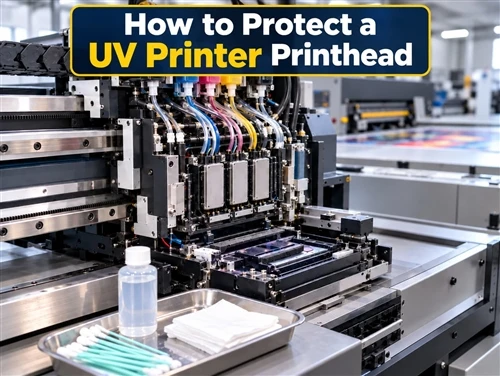
For UV printing, budget for printhead maintenance, cleaning fluid, filters, waste ink, white-ink circulation, UV components, service labor, fixture maintenance and downtime.
Thermal-transfer printers need ribbon, labels, platen rollers and eventually printheads, but they generally have a simpler ink-delivery architecture.
Energy can also differ substantially.Epson specifies approximately 4.2 kW power consumption for its 4 × 8 ft SureColor V7000 UV flatbed. Zebra's ZT411 documentation, by comparison, reports approximately 98 W during a specified printing test, although actual consumption depends on configuration and operating conditions.
At the July 2026 U.S. average commercial electricity price of approximately 14.53 cents/kWh, a 4.2 kW UV machine operating for 160 production hours would theoretically consume:
4.2 × 160 × $0.1453 = about $97.64/month
A 0.10 kW printer operating for the same 160 hours would use electricity worth only about:
0.10 × 160 × $0.1453 = about $2.32/month
The EIA notes that electricity prices vary substantially by location, so use your actual utility tariff in a TCO calculator.
Energy is usually not the biggest UV cost, however. Lost production time can matter much more.
If a machine contributes $150 per production hour and an unexpected printhead or ink-system problem removes eight hours of capacity, the opportunity cost is already:
8 × $150 = $1,200
That is why an extended warranty costing several thousand dollars can make economic sense for a production-critical UV printer but make little sense for a $3,000 backup thermal-transfer printer.
Waste costs are different too
Thermal transfer produces spent ribbon cores, used ribbon and release liner. UV systems may generate liquid waste ink, contaminated wipes and cleaning fluid.
Do not assume UV waste can automatically go into normal trash or a drain. Disposal should be based on the ink/cleaner's SDS and applicable federal, state and local waste classifications. California requirements, for example, may create a different handling cost than operating in another state.
Imported equipment can also introduce documentation, electrical-certification, ink-SDS and service considerations that should be included before comparing a factory-direct purchase with a locally supported machine.
Break-Even and ROI: How to Calculate It
The useful break-even formula is:
Break-even volume = Difference in fixed costs ÷ Difference in variable cost per item
Suppose the annualized fixed cost of UV is $3,000 higher than thermal transfer, but UV direct printing saves $0.15 on every finished product by eliminating a label and manual application.
The annual break-even quantity is:
$3,000 ÷ $0.15 = 20,000 items
Above 20,000 items per year, UV has recovered that additional annual fixed cost under these assumptions.
Now consider three production scenarios.
| Production Level | Likely Cost Winner | Why |
|---|---|---|
| 100 items/month | Thermal transfer in many label applications | Low capex dominates |
| 2,000 items/month | Depends on labor and finishing | UV may win if it removes manual transfer/application |
| 50,000 items/year | Strong case for workflow modeling | Automation, fixtures and eliminated secondary operations become important |
ROI should use incremental contribution, not revenue.Suppose moving from a $4,000 thermal-transfer workflow to a $21,000 UV system requires $17,000 of additional capital. If direct printing generates or saves $1,500 in contribution each month after ink, labor, rejects and maintenance:
$17,000 ÷ $1,500 = 11.3 months simple payback
If material cost rises 20%, labor rises $3/hour, or utilization drops from 70% to 40%, recalculate the model.
A useful downloadable spreadsheet should therefore contain equipment cost, financing payment, residual value, monthly units, image size, ink coverage, ribbon/media cost, operator wage, setup minutes, units/hour, reject rate, electricity rate, maintenance, post-processing and selling price.
Real-World Applications and Substrate-Specific Costs
Public customer case studies rarely disclose enough financial information to calculate a complete independent ROI, so avoid invented "real customer" profit numbers.
There are, however, useful verified operating examples.
Athena Controls' thermal-transfer installation reduced its reported label cost from roughly $0.20 to $0.13 while allowing the business to print variable labels internally and reduce inventory-related costs.
On the UV side, Washington-based Curiosity Puzzle Company moved printing in-house with a Roland VersaOBJECT MO-240 after experiencing color-quality problems with outsourced wooden puzzle printing. The value proposition was not simply cheaper ink; it was control over photographic color and direct printing onto the finished product.
Knotty Design Co. similarly reported adding UV printing to streamline production and later adding more capacity as order volume increased. That illustrates another cost that spreadsheets often miss: the economic value of shorter lead times and the ability to accept high-mix custom work.
Substrate choice can reverse the answer. Paper and standard polyester labels strongly favor thermal transfer. Acrylic, wood, coated metal and dimensional objects favor UV direct printing. Glass and difficult plastics may add primer or plasma-treatment costs. Fabric usually requires a separate heat-transfer, DTF or dye-sublimation comparison rather than a ribbon-based thermal-transfer model.
For a deeper look at rigid-material compatibility, see Dacen's UV flatbed printer material and ROI guide.
Which Technology Costs Less?
Choose thermal transfer when the job is primarily barcodes, serial numbers, durable monochrome labels, high-volume identification or inexpensive roll media.
Choose UV when the value comes from full-color direct decoration, white ink, varnish, variable graphics, rigid products, short custom runs, or eliminating labels and transfer steps.
The cheapest printer is not necessarily the lowest-cost production system.
Before requesting a quote, prepare your monthly quantity, product dimensions, substrates, image coverage, number of shifts, current labor time and current consumable cost.
Dacen can use those figures to recommend a suitable UV flatbed printer configuration and build a job-level comparison rather than relying on a generic cost-per-print claim. For industrial buyers, it is also worth comparing suppliers through the UV flatbed printer supplier guide.
FAQ
How do upfront costs of UV printers compare with thermal transfer printers?
Industrial thermal-transfer printers can cost only a few thousand dollars, while current commercial UV equipment starts around $9,000 and can exceed $100,000 for industrial flatbeds. UV therefore needs a stronger utilization or workflow-saving case to justify the capital.
What are typical per-item costs?
There is no universal figure. Thermal-transfer cost depends on ribbon, label stock and application labor. UV cost depends on printed area, ink coverage, white/varnish, primer, labor and rejects. Request costs in milliliters or square feet and calculate them against your actual artwork.
How do I calculate break-even volume?
Subtract the two processes' variable costs per finished item, then divide the difference in annual fixed cost by the variable-cost saving. Include labor and secondary operations, not just ink and ribbon.
Which technology has lower maintenance and energy costs?
Thermal transfer generally has the simpler mechanism and lower power demand. UV requires ink-system and printhead maintenance plus UV curing, although LED-UV systems are more efficient than older curing architectures.
How does substrate choice affect cost?
Paper and polyester labels generally favor thermal transfer. UV is more suitable for direct decoration on acrylic, wood, metal, glass, PVC and dimensional products, but difficult materials may require primer or pretreatment.
How much does an industrial UV printer cost?
Current U.S. examples range from about $9,299 for an Epson V1070 to approximately $20,000–$66,000 for professional benchtop systems, with production flatbeds reaching roughly $100,000–$200,000 or more depending on size and automation.
What are the main cost disadvantages of UV printing?
Higher capital cost, more complex printhead and ink-system maintenance, white-ink management, possible substrate pretreatment, higher downtime risk and more demanding service requirements. Thermal transfer remains economically superior when a simple durable label already solves the application.