

UV printing is widely used on plastics, acrylic, glass, metal, paper, wood, films, and many other materials. However, saying that "UV ink can print on almost any substrate" is only partly true.
A UV printer may be physically capable of depositing ink on a material, but that does not mean the finished print has acceptable adhesion, flexibility, abrasion resistance, chemical resistance, or outdoor durability.
Successful UV printing depends on the complete system:
substrate surface → cleaning and pretreatment → ink chemistry → wetting → UV curing → adhesion → end-use testing
Low-surface-energy plastics such as polyethylene and polypropylene often need corona, plasma, flame treatment, or an adhesion promoter. Glass and metals may already have relatively high surface energy but still fail because of oil, oxide, release agents, or poor chemical bonding. Flexible films and textiles require an ink film that can bend or stretch without cracking.
The following guide explains how to evaluate these variables before moving a job into production.
Substrate-by-Substrate UV Ink Compatibility Guide
Most industrial UV inkjet inks use free-radical acrylate chemistry. Urethane-acrylate modification is frequently used where additional flexibility and toughness are required. Specialty cationic systems based on epoxy or oxetane chemistry also exist, but they should only be used in printing systems specifically engineered for that chemistry.
For plastics, surface energy is a useful first screening tool.
Surface energy is normally expressed in mN/m, numerically equivalent to dynes/cm. Enercon's published treatment guidelines for UV printing show broad working ranges such as 38–50 mN/m for PE, 40–50 for PP, 42–54 for PET, 36–50 for PVC, and 40–52 for ABS in flexo/gravure UV applications. The exact requirement still depends on the ink and printing method.
A practical compatibility matrix is:
| Substrate | Practical Surface-Energy Starting Point | Recommended Ink/Formulation Direction | Typical Preparation | Suggested Initial Acceptance |
|---|---|---|---|---|
| PET | 42–54 mN/m | Free-radical UV; urethane-acrylate for flexible films | Clean; corona/plasma if required | ASTM D3359 ≥4B |
| PE | 38–50 mN/m | Flexible acrylate/urethane-acrylate | Corona, plasma, flame or PE adhesion promoter | ≥4B after conditioning |
| PP | 40–50 mN/m; often aim ≥44 for difficult jobs | Flexible UV acrylate | Corona/plasma + optional polyolefin primer | ≥4B |
| PVC | 36–50 mN/m | General-purpose flexible UV ink | Degrease; confirm plasticizer compatibility | ≥4B |
| ABS | 40–52 mN/m | General-purpose free-radical UV | Clean; plasma where necessary | ≥4B |
| Polycarbonate | Ink-specific | Flexible/tough UV acrylate | IPA-compatible cleaning; adhesion test | ≥4B |
| Acrylic / PMMA | Ink-specific | General or rigid UV ink | Clean; primer for routing/chipping resistance | ≥4B |
| Coated paper | Coating-specific | Standard UV acrylate | Usually no plasma; verify coating compatibility | Rub + tape test |
| Aluminum | Dyne value alone not sufficient | High-adhesion UV acrylate | Degrease; primer where necessary | ≥4B, preferably 5B |
| Stainless steel | Dyne value alone not sufficient | High-adhesion UV system | Degrease; plasma/primer if needed | ≥4B |
| Glass | Dyne value alone not sufficient | High-adhesion UV + silane/glass primer | Intensive cleaning + primer | ≥4B |
| Flexible textile | Surface energy not primary QC metric | Flexible polyurethane-acrylate system | Fabric-dependent pretreatment | Flex, crock and wash testing |
These figures are engineering starting points, not universal specifications.
For example, Nazdar lists a UV adhesion promoter for fluted polypropylene with surface tension at or above 44 dynes/cm, while separate primers are available for acrylic, rigid polyethylene, glass, and enamel-coated aluminum.
For rigid products, a useful internal production target is often ASTM D3359 4B or better, where less than 5% of the cross-cut area is affected; 5B represents no lattice detachment. The required pass level should still be specified by the customer or product standard.
ISO 2409 can also be used for cross-cut evaluation, although ISO emphasizes that the procedure evaluates resistance to separation rather than providing a quantitative measurement of adhesion strength.
Adhesion and Surface Preparation: Plastics, Metals & Glass
Good adhesion begins before the print button is pressed.
A practical troubleshooting sequence is:
Clean → Measure → Treat → Re-measure → Print → Cure → Condition → Adhesion Test
PE and PP: The Most Common Low-Energy Problems
Polyethylene and polypropylene have relatively low surface energy in an untreated state. UV ink may initially look good but peel away when scratched, routed, bent, or subjected to tape testing.
Corona treatment is one of the most common solutions for film.
Do not specify corona treatment only as:
"Set the corona machine to 2 kW."
Power alone is not reproducible because treatment also depends on film width and line speed.
A better process parameter is watt density:
Watt Density = Power / (Treatment Width × Line Speed × Number of Treated Sides)
Enercon notes that the relationship between watt density and resulting dyne level is not linear and varies by polymer, additives, starting surface condition, and equipment. PP generally requires substantially more treatment than PET to obtain a similar improvement.
For production setup:
Measure untreated surface energy.
Run corona/plasma at a controlled production speed.
Measure again immediately.
Aim for the ink supplier's minimum recommended surface energy.
Print a test strip.
Allow the print to complete any required post-cure development.
Perform a cross-cut/tape test.
Do not keep increasing corona power indefinitely. Excess treatment can damage a polymer surface and does not guarantee better bonding.
Corona treatment can also decay during storage, especially when additives or slip agents migrate back toward the film surface. Retesting immediately before printing is therefore advisable for critical PE and PP work.
Plasma Treatment
Atmospheric plasma is useful for shaped parts or difficult surfaces where corona is impractical.
Rather than specifying one universal plasma power and travel speed, qualify the process by the achieved result:
Treatment recipe → measured surface energy → adhesion result
Record:
nozzle-to-surface distance;
plasma power;
travel speed;
number of passes;
gas type;
time between treatment and printing.
These parameters are equipment-specific.
Flame Treatment
Flame treatment can also oxidize polyolefin surfaces, but flame height, burner distance, air-to-gas ratio, and exposure time are safety-critical.
Do not copy a generic burner distance or number of passes from another line. Use the flame-treatment system manufacturer's validated recipe and qualify it by surface-energy measurement and adhesion testing.
Metals
Aluminum and stainless steel do not normally fail because their inherent surface energy is too low.
More common problems are:
machining oil;
fingerprints;
silicone contamination;
oxide condition;
protective coatings;
polishing compounds.
A reliable sequence is:
degrease → dry → inspect for water-break-free cleanliness → plasma or primer if necessary → print
PU-modified or other high-adhesion UV systems are often preferred when the finished part will later be bent or formed.
Glass
Glass can appear easy to print because UV ink wets it well, yet adhesion may remain poor.
Silane-based glass primers are commonly used to improve bonding between the inorganic glass surface and an organic coating. Commercial UV inkjet suppliers also offer dedicated wipe-on glass primers for this reason.
A useful glass troubleshooting sequence is:
Poor adhesion → remove oils/silicones → verify complete drying → apply validated glass primer → UV print → fully cure → wait specified conditioning period → cross-cut test
Do not evaluate adhesion immediately after printing if the ink/primer supplier specifies a post-cure development period.
Flexible Substrates and Textile Performance
A UV ink that performs perfectly on acrylic may fail completely when used on flexible vinyl, PET film, artificial leather, or textile.
The difference is mechanical.
Rigid UV formulations can develop high hardness and scratch resistance but may crack when the material is folded or stretched.
Flexible systems therefore often incorporate polyurethane-acrylate chemistry or other flexible oligomer structures. Published research on UV-curable polyurethane acrylates shows their suitability for flexible PET and textile printing because the polymer structure can improve flexibility and mechanical performance of the cured film.
Define the Required Elongation First
Do not specify "flexible ink" without defining the end use.
A practical internal qualification might require:
non-stretch film: survive repeated 180° folding without visible cracking;
moderately flexible product: survive approximately 10–25% strain;
stretch application: test at 25%, 50%, or greater elongation depending on the actual garment or product.
These are engineering qualification levels rather than universal industry standards.
The required strain should be based on what the finished article experiences in service.
Keep Ink Deposits Under Control
A thicker UV layer is generally more likely to crack during bending.
This becomes especially important with:
White → CMYK → varnish
because the total cured film can be considerably thicker than CMYK alone.
For flexible work:
minimize unnecessary white density;
use a flexible white formulation;
avoid excessive varnish thickness;
use pinning rather than fully curing each intermediate layer where the ink system allows it;
verify intercoat adhesion after final cure.
Textile Testing
For washable textiles, appearance after printing is not enough.
AATCC TM61 evaluates accelerated laundering behavior, while AATCC TM8 evaluates color transfer caused by rubbing or crocking.
A reasonable customer-specific QC specification might be:
color change after the agreed AATCC TM61 cycle: Grade 4 or better;
dry crocking: Grade 4 or better;
wet crocking: Grade 3–4 or better;
no visible cracking after the defined elongation/flex cycle.
These grades are suggested purchasing specifications, not universal pass/fail limits defined by AATCC.
Ink Rheology Matters Too
Substrate compatibility cannot be separated from printhead compatibility.
For example, Ricoh specifies approximately 10–12 mPa·s viscosity and 28–35 mN/m surface tension for several of its industrial printheads, while other printheads operate with different viscosity windows.
Agfa also publishes UV ink examples around 7–9 mPa·s at 45°C, illustrating why jetting temperature is part of the specification.
Production practice should include:
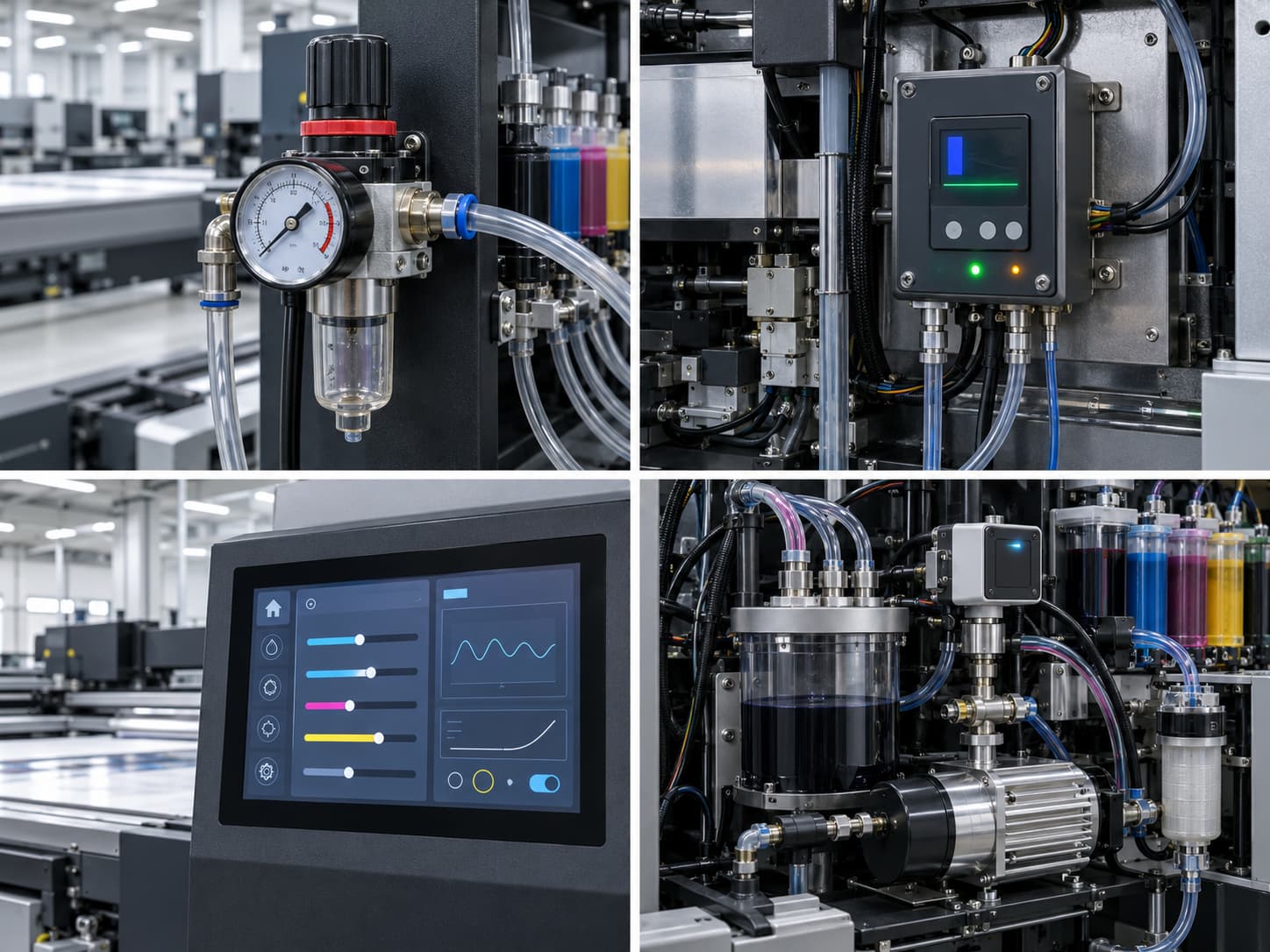
controlled ink temperature → correct filtration → degassing → stable negative pressure → recirculation where required
especially for white ink.
Curing, Crosslinking and Process Parameters: LED vs. Mercury
Adhesion problems are frequently blamed on the substrate when the actual problem is incomplete curing.
UV dose is generally expressed in:
mJ/cm²
while instantaneous irradiance is expressed in:
mW/cm² or W/cm².
Simplified:
UV dose ≈ irradiance × exposure time
but spectral output, lamp distance, ink absorption, pigment concentration, and oxygen inhibition also matter.
LED UV
Current industrial LED curing systems commonly use:
365 nm;
385 nm;
395 nm;
405 nm.
High-performance industrial LED systems are commercially available across these wavelengths, including units designed specifically for digital inkjet printing.
The ink's photoinitiator package must match the lamp spectrum.
For example, one commercial UV inkjet formulation from Nazdar specifies 395 nm LED output of at least 2 W/cm², while another specifies a 395 nm, 4 W/cm² or greater dual-lamp system. A different UV inkjet series calls for 395 nm and at least 6 W/cm². These variations show why curing should follow the individual ink TDS rather than a universal lamp number.
Mercury UV
Medium-pressure mercury lamps provide a broader UV spectral distribution.
Published UV ink systems provide useful examples of cure-energy scale. Depending on formulation, commercial technical data commonly shows starting ranges around:
100–200 mJ/cm²
with some high-opacity whites, blacks, or thick coatings requiring higher energy.
These values should not be copied directly from one ink family to another.
White Ink Needs Special Attention
White UV ink contains a high concentration of titanium dioxide pigment.
That opacity is useful for printing on glass, metal, dark plastics, and transparent materials, but it can also make depth curing more difficult.
A better strategy is often:
controlled white-film thickness → pinning if required → final full cure
rather than depositing an excessively thick white layer and trying to cure it in one step.
For thick white or multilayer work:
check the ink manufacturer's required wavelength;
measure lamp irradiance with a radiometer;
reduce carriage/belt speed if more dose is required;
increase lamp output within the approved range;
use additional cure passes where supported;
control substrate temperature.
How to Confirm Cure
Start with simple production checks:
surface tack;
thumb twist;
scratch resistance;
tape test;
odor comparison.
Commercial ink suppliers explicitly recommend touch, twist, and scratch evaluation after the print has cooled.
For laboratory development, more detailed methods can include:
FTIR conversion analysis;
pendulum or pencil hardness;
solvent resistance;
residual extractables;
differential scanning methods where appropriate.
Undercure can cause tackiness, poor adhesion, low abrasion resistance, residual odor, and increased migration risk.
Overcure can make some ink films more brittle and may reduce interlayer adhesion or flexibility. Ink suppliers therefore recommend determining cure under actual production conditions rather than simply maximizing UV output.
Durability Testing, Accelerated Weathering and Regulatory Notes
A substrate/ink combination should be qualified according to its final use.
Adhesion
Use:
ASTM D3359 or ISO 2409
for cross-cut/tape evaluation where applicable.
For many industrial graphics applications:
4B or better is a useful internal starting requirement, with 5B preferred for demanding applications. Under ASTM's classification, 4B corresponds to less than 5% affected area.
Abrasion
ASTM D4060 uses a Taber Abraser to evaluate the abrasion resistance of organic coatings on rigid surfaces.
Do not publish a statement such as:
"1,000 cycles means the print passes."
without also stating:
abrasive wheel;
load;
cycle count;
coating thickness;
measured mass loss or appearance criterion.
Those variables significantly affect results.
Accelerated Weathering
ASTM G154 uses fluorescent UV exposure combined with controlled moisture conditions to evaluate weathering effects on non-metallic materials. ASTM recommends documenting the actual exposure conditions and using known control materials because the practice does not provide one universal exposure cycle for every product.
For xenon-arc testing, ISO 4892-2 is commonly used to expose plastic specimens to filtered xenon light with controlled temperature, moisture, and humidity conditions.
A typical validation program records:
0 h → 250 h → 500 h → 1,000 h
and measures:
ΔE color change;
gloss retention;
cracking;
yellowing;
adhesion;
chalking.
Do Not Convert Weatherometer Hours Directly Into Years
A statement such as:
"1,000 hours of UV testing equals five years outdoors"
is usually not defensible without a validated material-specific correlation.
Outdoor degradation depends on:
geographic UV exposure;
temperature;
humidity;
rainfall;
mounting angle;
substrate;
pigment;
ink thickness.
ASTM G154 itself emphasizes comparative exposure and documented conditions rather than assigning a universal real-world time multiplier.
The better approach is to expose a control product with known field performance alongside the new system and build a correlation using both accelerated and real outdoor data.
Food-Contact Applications
Standard UV ink should never automatically be described as "food safe."
FDA notes that components of food-contact materials that can reasonably migrate into food require an appropriate regulatory basis for their intended use. Food-contact authorization is use- and substance-specific.
This is especially relevant for UV printing because residual monomers and photoinitiators can potentially migrate through packaging, transfer by set-off, or enter food through other mechanisms. FDA has specifically studied photoinitiators used in printing inks on the exterior of food packaging.
For food-packaging projects, define:
ink formulation → packaging structure → barrier layer → print side → set-off risk → intended food → temperature/time conditions → migration testing
before claiming compliance.
Operator Safety and Waste
Uncured UV ink should be handled according to its SDS, typically including suitable gloves and eye protection.
Waste ink also cannot automatically be treated as ordinary trash. EPA notes that printing waste can become hazardous depending on solvents, metals, ignitability, and other characteristics, so waste classification must be based on the actual material and applicable federal/state requirements.
Request a UV Ink Compatibility Test for Your Material
Unsure whether your product can be printed directly with UV ink?
Download the UV Substrate Compatibility Quick Reference
Compare PET, PP, PE, PVC, acrylic, glass, metal, and other common substrates by surface preparation, ink type, and adhesion-testing method.
Request a Free Material Print Test
Send us your actual product or substrate and receive a recommended printing configuration.
Request an Adhesion & Curing Report
Available test data can include:
surface-energy measurement;
pretreatment recommendation;
UV curing configuration;
cross-cut/tape adhesion result;
abrasion or flexibility testing.
For the most accurate recommendation, provide the material type, surface coating, application, required durability, product photo, and expected indoor or outdoor service environment.
FAQ
What surface energy should I target for PET, PP, and PE before UV printing?
As a starting point, published UV-printing treatment guidance lists approximately 42–54 mN/m for PET, 40–50 mN/m for PP, and 38–50 mN/m for PE in certain UV printing applications.
For difficult UV inkjet applications, working toward the upper part of the range can improve wetting, but the final requirement should always be established using the actual ink and adhesion test.
How should I set corona, plasma, or flame treatment for polypropylene?
Do not use one fixed kW value.
For corona systems, calculate treatment based on power, treatment width, line speed, and number of treated sides. Adjust treatment until the required surface energy is achieved, then verify it with an adhesion test.
PP is relatively difficult to treat, so a higher treatment intensity may be required than for PET. The final recipe should be recorded as both the machine parameters and the measured post-treatment dyne value.
Plasma and flame settings should follow the treating-equipment manufacturer's validated process rather than a universal nozzle distance or number of passes.
What UV dose is required for high-opacity white ink on glass or metal?
There is no universal white-ink dose.
Actual requirements depend on pigment loading, film thickness, lamp spectrum, ink chemistry, carriage speed, and number of layers.
Published commercial UV systems illustrate cure-energy ranges from roughly 100–200 mJ/cm² for many conventional formulations, with opaque whites sometimes requiring substantially more. LED inkjet products may instead specify required lamp irradiance-for example 395 nm sources rated at 2, 4, or 6 W/cm² depending on the ink system.
Always use the ink manufacturer's TDS and verify the finished print with adhesion, scratch, and cure tests.
Which tests should I use for flexible or washable UV prints on textiles?
For textiles, consider:
AATCC TM61 for accelerated laundering;
AATCC TM8 for crocking/color transfer;
an application-specific elongation test;
repeated folding or flex testing;
visual examination for cracking or delamination.
AATCC identifies TM61 and TM8 as standardized methods for laundering and crocking evaluation.
The required pass grades should be defined by the buyer and intended application rather than assumed to be universal.
What primers work best for aluminum and stainless steel?
Begin with cleaning because oils and surface contamination commonly cause failure.
Where additional adhesion is required, use an adhesion promoter validated for the specific metal, coating, and UV ink. Silane-containing or other chemically functional primers may be appropriate for oxide-rich surfaces, while PU-compatible adhesion systems can be useful where flexibility is required.
Commercial UV ink suppliers offer dedicated adhesion promoters for metal, glass, acrylic, and plastic applications.
Always verify the primer/ink combination rather than assuming that any general-purpose metal primer is compatible.
How should I design accelerated weathering and migration tests?
For outdoor durability, establish baseline color, gloss, adhesion, and appearance, then expose matched specimens using a defined ASTM G154 or ISO 4892-2 procedure. Measure the same properties at scheduled intervals and include a known control material whenever possible.
Do not convert laboratory exposure hours directly into outdoor years unless you have established a field correlation.
For food-contact applications, determine the regulatory status of every relevant component and develop migration testing around the actual food type, packaging structure, contact conditions, time, and temperature. FDA evaluates food-contact substances partly through migration and toxicological data under their intended conditions of use.