

Choosing a UV flatbed printer supplier is not simply a matter of comparing maximum resolution or advertised print speed. For U.S. buyers, local service coverage, warranty terms, replacement-part availability, training, ink cost, application testing, and actual production throughput can matter more than brochure specifications.
There is also an important limitation when discussing "top-rated" suppliers: comparable U.S. installation numbers, dealer response-time statistics, and customer NPS scores are generally not published across all manufacturers. Any ranking claiming precise market-share or service scores without source data should therefore be treated cautiously.
The shortlist below is based on publicly verifiable U.S. product availability, service infrastructure, published warranty programs, specifications, pricing transparency, and suitability for different production levels.
Top-Rated UV Flatbed Printer Manufacturers for the U.S. Market
For 2026 purchasing decisions, these suppliers deserve consideration:
| Supplier | Strongest Buyer Fit | Representative U.S. Model | Main Strength |
|---|---|---|---|
| Mimaki | Small-to-mid-size personalization shops | UJF-3042 MkII e / UJF-6042 MkII e | Mature direct-to-object ecosystem |
| Roland DG | Commercial customization and specialty printing | VersaOBJECT CO-300i / LO-640 | Dealer support, warranty, financing |
| Epson | Desktop through 4×8 commercial production | V1070 / V4000 / V7000 | Broad U.S. service infrastructure |
| Canon | Established sign shops and production environments | Arizona 135 GT / Arizona 1300 | Industrial flatbed platform |
| EFI | High-volume industrial production | EFI Pro 30f+ | High throughput and multilayer production |
| Mutoh | Mid-size specialty production | XpertJet 1462UF | Compact commercial platform |
| Dacen | Buyers prioritizing configurable hardware and direct sourcing | DG-2513 / DG-9070 | Configuration flexibility and factory-direct evaluation |
Mimaki
Mimaki remains one of the strongest choices for direct-to-object businesses. The UJF-3042 MkII e currently carries a U.S. promotional price around $19,995, offers a 300 × 420 mm print area, 5 pL minimum drop size, white/clear/primer configurations, and a one-year warranty. The larger UJF-6042 MkII e expands the bed to approximately 600 × 420 mm and prints objects up to 153 mm thick.
Mimaki also has U.S. technology centers in Georgia, Texas, California, and New Jersey and directs warranty work through its authorized dealer network. Its standard Total Care program provides at least one year of printer coverage, with extended service options available.
Roland DG
Roland's VersaOBJECT line is particularly relevant for commercial product customization. The CO-300i-F2 has recently been advertised around $39,995 promotional pricing, while the larger LO-640-F3 carries a U.S. MSRP of $94,695. Both can accommodate objects up to approximately 242 mm high. Roland publishes two-year coverage for the CO-300i and one year for the LO-640, subject to registration and approved-ink requirements.
Roland also publicly offers 60-month financing examples and extended service contracts, making capital planning more transparent than with many industrial systems.
Epson
Epson now spans three useful UV-flatbed levels. The compact SureColor V1070 is listed at $9,299; the 2026 SureColor V4000 is listed at $53,995; and the 4 × 8 ft SureColor V7000 targets full-sheet signage and rigid-media production.
The V7000 supports a 2,500 × 1,250 mm printing area, media up to 80 mm thick, 10-color UltraChrome UV ink including white and varnish, and approximately 4.2 kW operating power consumption. Epson also sells next-business-day on-site extended service plans for the V7000, subject to geographic and contract conditions.
Canon
Canon's Arizona platform is better aligned with established sign and display businesses than with desktop personalization.
The Arizona 135 GT provides a rigid-media area of approximately 1,250 × 2,500 mm, supports media up to roughly 50 mm thick, and publishes production speed around 224 ft²/hr-or approximately 20.8 m²/hr-with faster express modes available. Canon's published U.S. warranty for Arizona 135/1300/2300/6100 products is two years for the printer, while printhead warranty coverage is 90 days.
That printhead distinction is important when comparing service contracts.
EFI
EFI should be evaluated when throughput is a primary purchasing criterion.
The EFI Pro 30f+ offers a 120 × 80 in. bed, media thickness up to approximately 102 mm, up to 1,200 × 1,200 dpi output, 5 pL variable droplets, standard white ink, optional clear ink, and production-quality throughput around 581 ft²/hr, or approximately 54 m²/hr. EFI also publishes a much higher maximum productivity figure, but buyers should not compare that maximum directly with another machine's quality-mode speed.
Mutoh
Mutoh's XpertJet 1462UF occupies an interesting middle ground between small benchtop machines and full 4 × 8 production flatbeds.
It has a 1,420 × 700 mm printing area, supports objects up to 150 mm thick, uses CMYK plus white and varnish, and consumes no more than approximately 1,030 W during operation. Current U.S. MSRP is listed at $69,995.
Dacen
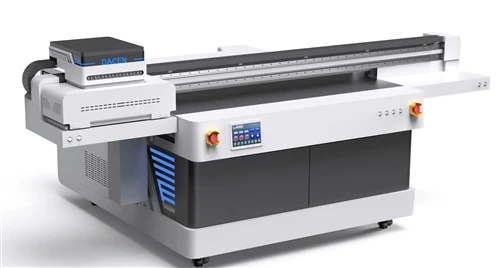
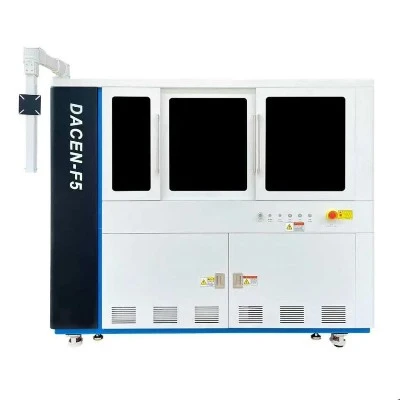
Dacen is worth evaluating differently from the established U.S. dealer-network brands. It operates as a direct UV-equipment manufacturer and offers configurations ranging from its 900 × 700 mm A1 flatbed to 2,500 × 1,300 mm industrial platforms.
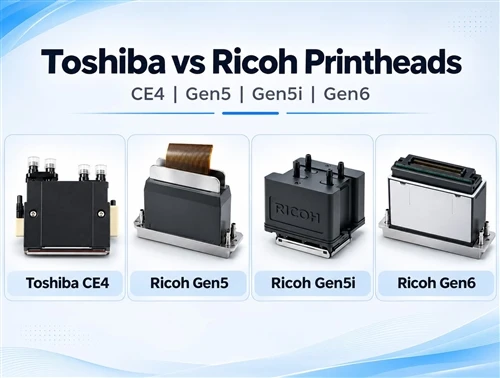
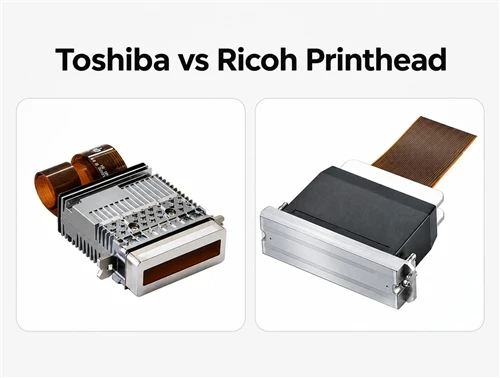
The Dacen DG-2513A UV flatbed printer uses Epson I3200 printheads and publishes 16.4 m²/hr in four-pass draft mode, 10.8 m²/hr in six-pass production mode, and 7.9 m²/hr in eight-pass high-resolution mode.
Dacen's UV flatbed printer range is particularly relevant when a buyer needs configuration flexibility, custom fixtures, high-drop printing, or factory-direct sample testing. U.S. buyers should, however, request the exact service arrangement, spare-parts stocking policy, response time, and warranty exclusions in writing before purchase rather than assuming the same local field-service structure offered by domestic dealer networks.
Side-by-Side UV Flatbed Printer Comparison
Published maximum-speed numbers are not standardized. Different manufacturers test different resolutions, passes, colors, white layers, image coverage, and quality modes.
The following table therefore shows published values, not an assertion that each speed represents equal print quality.
| Model | Print Area | Max. Object Thickness | Published Speed | Resolution | Drop Size | White / Varnish |
|---|---|---|---|---|---|---|
| Mimaki UJF-6042 MkII e | 600 × 420 mm | 153 mm | 3.5 m²/hr | 1200 × 1200 dpi | 5 pL | Yes / Yes |
| Roland LO-640 | 1520 × 2450 mm | 242 mm | ≈5.0 m²/hr* | Not directly comparable | - | Yes / Yes |
| Epson V7000 | 2500 × 1250 mm | 80 mm | Request mode-specific test | 720 × 1440 dpi max. | Variable | Yes / Yes |
| Canon Arizona 135 GT | ≈1250 × 2500 mm | ≈50 mm | 20.8 m²/hr production | - | 6–42 pL | White option varies |
| EFI Pro 30f+ | 3050 × 2030 mm | 102 mm | 54 m²/hr production quality | 1200 × 1200 dpi | 5 pL | Yes / Optional clear |
| Mutoh XPJ-1462UF | 1420 × 700 mm | 150 mm | Mode-dependent | Up to 1440 dpi family | - | Yes / Yes |
| Dacen DG-2513A | 2500 × 1300 mm | 100 mm | 10.8 m²/hr production | Configuration dependent | 3.8 pL | Yes / Yes |
*Roland's stated throughput on the LO-640 is application/configuration dependent.
Substrate compatibility
Acrylic, PVC, wood, coated metal, aluminum-composite panels, glass, ceramics, leather, and selected plastics can all be UV printed-but "printable" does not automatically mean "no pretreatment required."
Glass, some metals, polypropylene, polyethylene, silicone-treated materials, and certain coated plastics may require primer, plasma, flame treatment, or another adhesion process. Every supplier should therefore print the buyer's actual substrate, not merely a generic sample from its showroom.
For unusual objects or thicker parts, Dacen's DG-9070 A1 UV flatbed provides a 900 × 700 mm working area and a published maximum object height up to 400 mm, making sample validation especially important for dimensional products.
Warranty, Service, Installation and Training
For U.S. procurement, compare warranty language line by line rather than accepting "one-year warranty" as sufficient.
Mimaki's standard North American Total Care coverage is 12 months and includes authorized service labor under its terms, with service agreements available for longer coverage. Roland publishes one- or two-year warranties on current VersaOBJECT flatbeds depending on model and offers extended service contracts. Canon provides two-year Arizona printer coverage but only 90 days on printheads. Epson offers paid V7000 service plans that include next-business-day on-site repair under qualifying geographic and timing conditions.
Before signing a purchase order, require the supplier to state five items in writing: technician response target, whether travel is included, printhead exclusions, stocked critical parts, and who pays freight for failed components.
Installation should also include electrical/site inspection, printer leveling, RIP setup, color-management basics, maintenance training, nozzle-recovery procedures, white-ink maintenance, substrate testing, and operator sign-off.
U.S. Supplier Directory, Lead Times and Verification
For the Northeast, ITNH in New Hampshire is a long-standing authorized Mimaki distributor providing installation, training, support, and service. Mimaki also operates a New Jersey technology center.
In the Midwest, IT Supplies operates a showroom and solution center in Rolling Meadows, Illinois, while Epson also identifies IT Supplies and other regional partners through its professional demo-center network.
For the South, Mimaki has facilities in Georgia and Texas, while PDS Equipment operates from Nashville. On the West Coast, Mimaki has a Los Angeles-area technology center and Roland DGA is headquartered in Irvine, California.
Nationally, Grimco reports more than 65 North American locations and carries brands including Roland and Epson, providing another route for equipment and regional support.
Do not assume a published dealer address means a specific printer is in stock. Large flatbeds may require factory allocation, rigging, site preparation, and installation scheduling. Ask for a written ship date, serial-number allocation date, delivery date, installation date, and technician availability.
Independent cross-brand durability tests are also less common than buyers might expect. Instead of accepting a sample labeled "scratch resistant," request documented adhesion, abrasion, chemical, outdoor-weathering, and wash tests using your actual substrate and ink configuration.
A credible supplier should be willing to identify the sample machine, ink type, print mode, pretreatment, curing conditions, sample date, and test method.
Request a Real Production Sample
FAQ
Which UV flatbed printer manufacturers are best for small shops versus production facilities?
Small personalization shops should compare machines such as the Epson V1070 and Mimaki UJF series. Mid-size commercial businesses can evaluate Roland, Mimaki, Mutoh, Epson V4000, and comparable Dacen configurations. High-throughput sign and display operations should also evaluate Canon Arizona, Epson V7000, EFI, and industrial 4 × 8-class systems.
How do I compare bed size and throughput?
Start with the largest substrate you actually sell, then add loading clearance and fixture space. Compare throughput only when suppliers print the same file, at the same target quality, using the same number of ink layers. Maximum brochure speed alone is not a reliable production comparison.
What are realistic ongoing ink and consumable costs?
They depend heavily on image coverage, white ink, varnish, primer, cleaning cycles, rejected work, and ink price. Ask each supplier to process your test artwork through its RIP and provide estimated milliliters of each ink per job.
What warranty and response time should I require?
At minimum, get written coverage for parts, labor, printheads, travel, remote support, and response time. For production-critical equipment, also request pricing for an extended service plan and confirm which critical parts are stocked within the United States.
How can I verify performance claims?
Send identical substrates and artwork to competing suppliers. Require a timed print test, labeled sample, nozzle test, adhesion test, abrasion test, and written settings. For industrial purchases, conduct a live or recorded factory acceptance test before shipment.
What financing and leasing options are available?
Options vary by manufacturer and dealer. Roland publicly advertises 60-month lease examples on some systems, while national dealers frequently offer third-party equipment financing. Compare total financed cost, buyout terms, early-payoff penalties, service coverage, and whether installation and consumables can be included in the financed amount.