





Industrial 2.5 × 1.3 m UV Flatbed Printing System
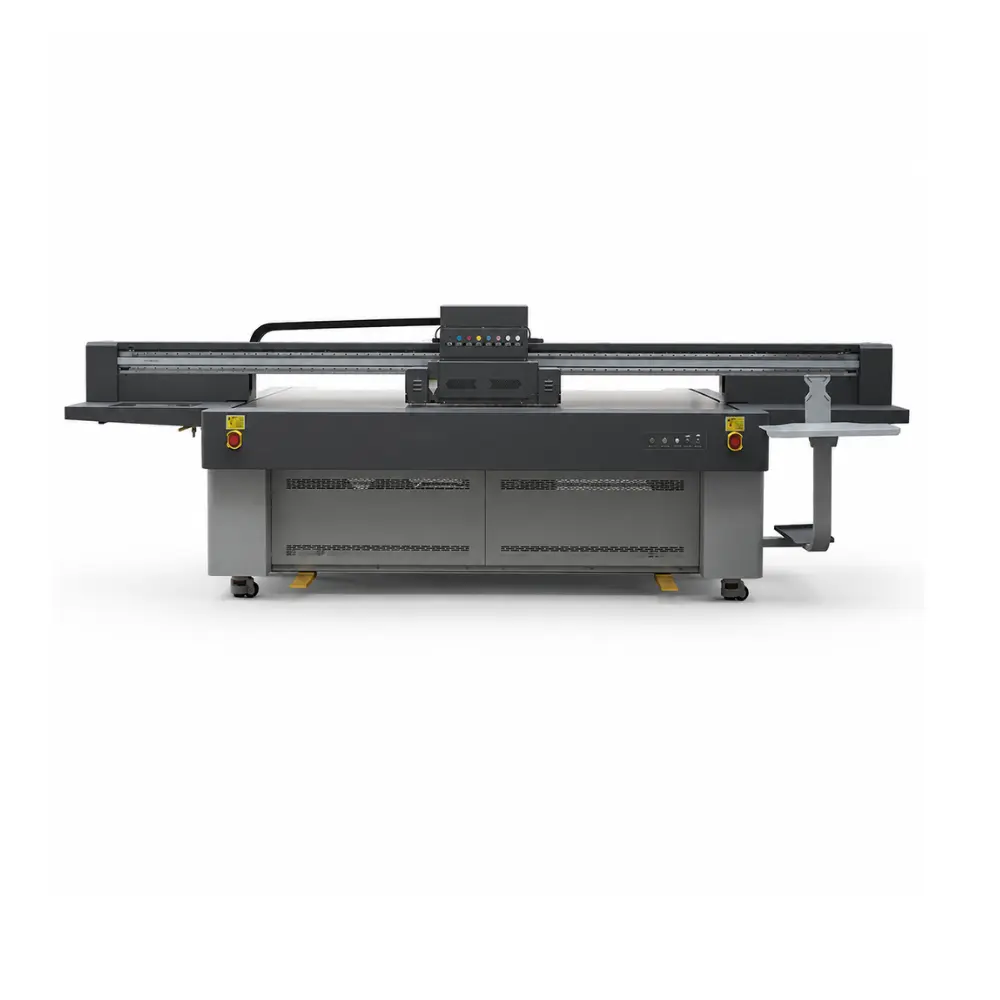
DG-2513 Industrial UV Flatbed Printer
Print full-color, white and varnish graphics directly onto rigid sheets, flexible substrates and selected dimensional products with a configurable industrial UV printing platform.
The DG-2513 combines a 2500 × 1300 mm print area with selectable printhead, ink and curing configurations. It is designed for sign companies, decoration manufacturers, packaging producers and industrial product printers that need to handle multiple materials, order sizes and finishing requirements on one machine.
From standard CMYK graphics to white underbase, spot varnish and layered texture, the DG-2513 helps businesses move from plate-based production to a more flexible direct-to-product workflow.
DG-2513 Industrial UV Flatbed Printer Products
-
![Inkjet Printer UV Digital Printing Machine 2513]() Inkjet Printer UV Digital Printing Machine 2513Inkjet printer UV digital printing machine 2513,which will not have any chemical reaction with ink.Equipped with anti-collision system,the print head can be protected from damages caused by human
Inkjet Printer UV Digital Printing Machine 2513Inkjet printer UV digital printing machine 2513,which will not have any chemical reaction with ink.Equipped with anti-collision system,the print head can be protected from damages caused by human -
![UV Flatbed Printer 2513 With EPSON I3200]() UV Flatbed Printer 2513 With EPSON I3200Automatic UV flatbed printer 2513 model all accessories of ink system are certified by ink supplier,which will not have any chemical reaction with ink.Equipped with anti-collision system,the print
UV Flatbed Printer 2513 With EPSON I3200Automatic UV flatbed printer 2513 model all accessories of ink system are certified by ink supplier,which will not have any chemical reaction with ink.Equipped with anti-collision system,the print


A 2513 UV Printer Built for Flexible Production
The DG-2513 is designed for businesses that need to produce different products without investing in a separate printing process for every application.
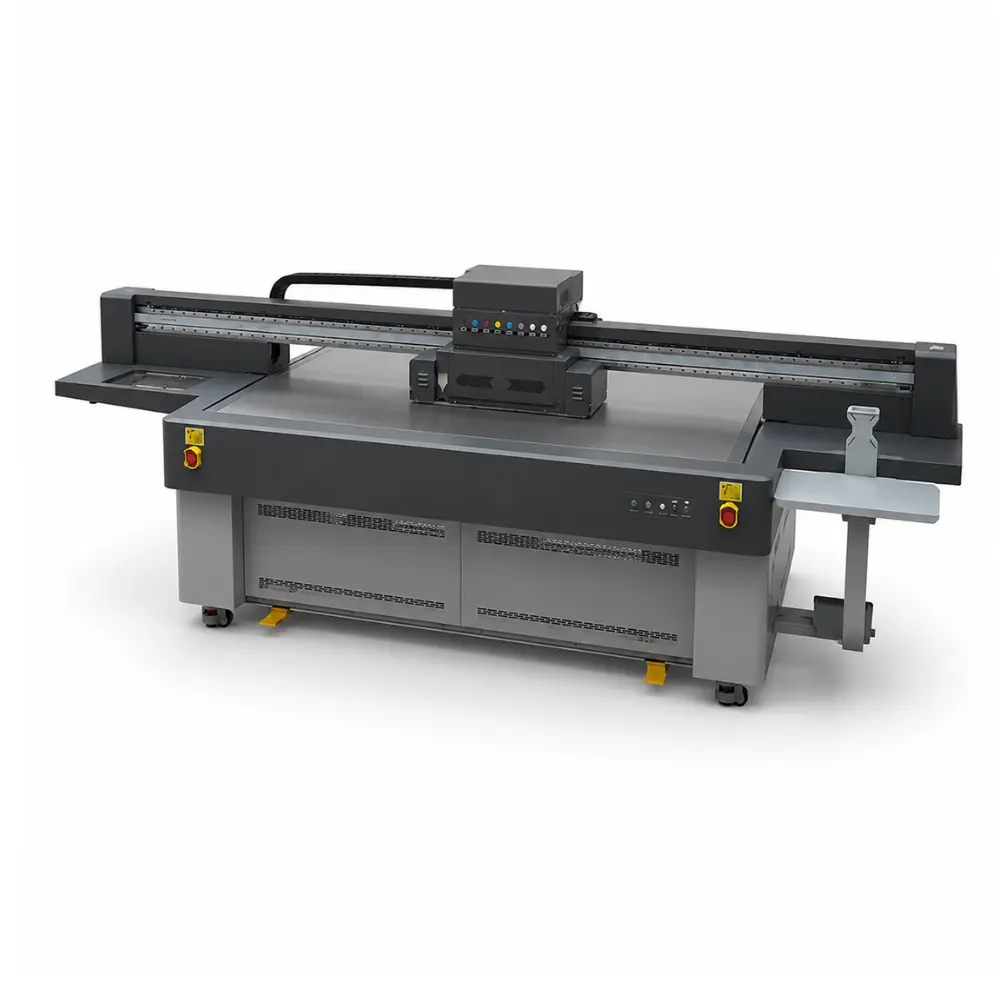
Its 2500 × 1300 mm working area can accommodate full-size sheets, multiple smaller panels or repeated products positioned in a custom fixture. This makes the printer suitable for one-off samples, customized orders, short production runs and selected repeat-volume work.
Instead of selecting the machine only by maximum speed or printhead brand, the DG-2513 can be configured according to five practical production factors:
- What material will be printed?
- Is the surface flat, recessed or raised?
- Is white ink or varnish required?
- What level of image detail is expected?
- What is the required daily or monthly output?
This application-based approach helps avoid paying for unnecessary capacity while reducing the risk of selecting a configuration that cannot meet the intended production requirements.
For Sign and Display Printers
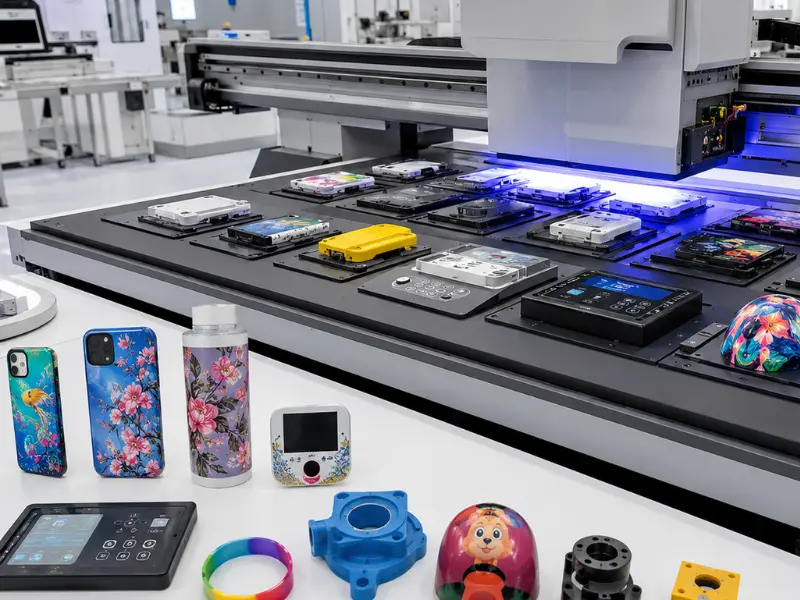
Produce acrylic signs, PVC foam boards, exhibition panels, directional signage, retail displays and promotional graphics without conventional screen preparation.
White ink can improve color visibility on dark or transparent substrates, while optional varnish can add gloss contrast to logos, patterns and selected graphic areas.
The DG-2513 is suitable for sign companies that need to handle frequent artwork changes, customized sizes and short-run orders without creating a new screen or printing plate for each job.
Typical products include:
Acrylic signs/PVC foam board/Exhibition graphics/Directional signs/Retail display panels/Point-of-purchase graphics/Branded decorative panels
For Interior Decoration Manufacturers
Print decorative graphics directly onto selected wood, glass, metal, ceramic and furniture-related panels.
The large flatbed area supports customized interior projects where patterns, colors and order quantities change frequently. White ink, selective varnish and layered printing can also be used to create premium decorative effects.
Surface treatment may be required for glass, polished metal and selected coated materials. Material samples should be tested according to the required scratch resistance, adhesion and service environment.
Typical products include:
MDF decorative panels/Plywood components/Cabinet panels/Glass decoration/Ceramic tiles/Metal wall panels/Furniture components/Customized interior signage

For Packaging and Prototype Producers
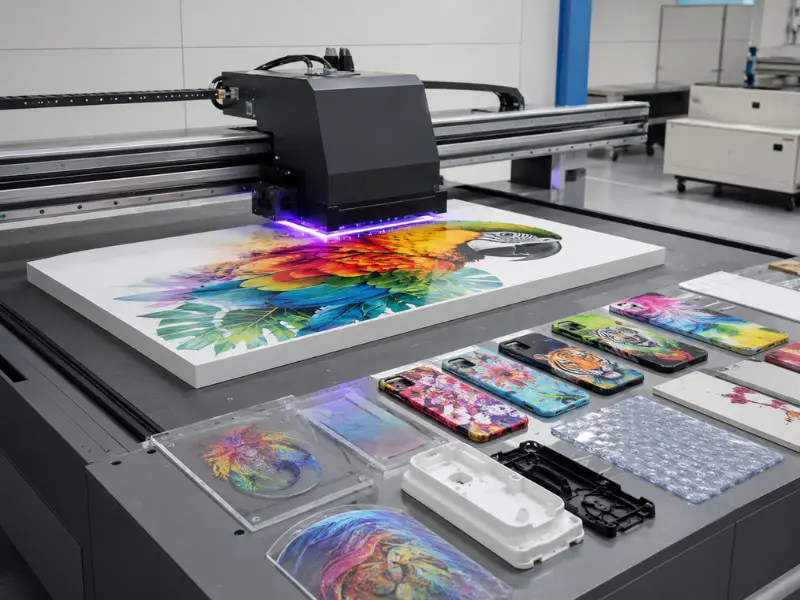
Create full-color packaging samples, rigid box prototypes, presentation kits and short-run cartons without conventional plate-making.
Digital UV printing is especially useful during packaging development because artwork, colors, white ink areas and varnish effects can be adjusted between samples without remaking screens or printing plates.
The DG-2513 allows packaging producers, design agencies and brand suppliers to evaluate graphics and finishing effects before moving a project into mass production.
Typical products include:
Rigid gift boxes/Corrugated packaging samples/Presentation boxes/Branded sample kits/Prototype cartons/Display packaging/Short-run promotional packaging
For Industrial Product Decorators
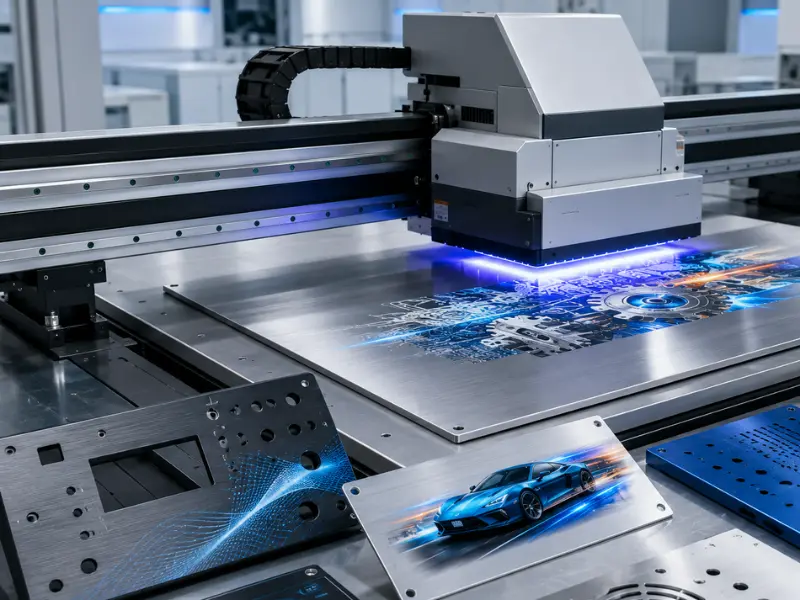
Print operating graphics, identification marks, decorative patterns and selected functional information directly onto compatible industrial panels and components.
Suitable fixtures can help position repeated products for batch printing. Applications with recessed areas, raised edges or uneven surfaces should be evaluated for print gap, image distortion and carriage clearance before production.
Typical products include:
Control panels/Equipment covers/Instrument panels/Metal nameplates/Plastic housings/Molded product covers/Identification panels/Selected industrial components
Replace Multiple Printing Processes with One Configurable Platform
Traditional screen printing remains effective for stable, high-volume orders, but it can become inefficient when artwork, materials or order quantities change frequently.
The DG-2513 gives manufacturers a direct digital printing option for jobs that require more flexibility.
| Production Challenge | DG-2513 Workflow |
|---|---|
| Screen preparation increases the cost of short runs | Direct digital printing without screens or plates |
| Different materials require different production routes | Configurable ink, primer and surface-treatment workflow |
| Colors appear weak on dark or transparent materials | White ink underbase and multilayer printing |
| Large sheets can move during carriage travel | Vacuum hold-down system with configuration-dependent zones |
| Raised or recessed surfaces create collision risk | Standard and application-specific print-gap configurations |
| White pigment can settle during standby periods | Configuration-dependent white ink agitation and circulation |
| Buyers are unsure which printhead to select | Application-based printhead recommendation |
| Operators need help after delivery | Installation guidance, training and remote troubleshooting |
The purpose is not to claim that one machine can print every material without preparation. The purpose is to build a controlled production workflow around the materials, products and quality requirements that matter to your business.
Discuss Your Printing Application
Choose the DG-2513 Configuration for Your Application
Different printheads are designed around different droplet, speed, durability and print-gap requirements.
The correct DG-2513 configuration depends on your product rather than the printhead name alone. Dacen reviews the material, product height, desired image quality, ink channels, expected output and operating budget before recommending a configuration.
Configuration Overview
| Configuration | Recommended Production Direction | Main Priority | Typical Applications |
|---|---|---|---|
| Epson i3200 | Commercial printing and flexible production | Fine detail and accessible production capacity | Signs, acrylic, packaging samples and decorative panels |
| Toshiba Configuration | Selected dimensional and high-drop applications | Greater tolerance for controlled surface variation | Molded products, trays, shoes and recessed components |
| Ricoh G5/G6 | Continuous industrial production | Industrial operation and balanced output | Panels, decoration and industrial product printing |
| Konica KM1024i | Repeat flat-sheet production | Productivity on stable flat substrates | Sign boards, panels and repeated sheet work |
The current printhead model, quantity, ink arrangement, speed and high-drop capability must be confirmed in the final quotation.
Why Work with Dacen for Your UV Printing Project
Dacen was established in 2012 and focuses on UV digital printing equipment.
The value of working with a specialized UV printer supplier should come from application evaluation, configuration support and long-term production assistance rather than only the initial machine price.
Application-Based Configuration
Machine recommendations are based on the actual material, product shape, image quality, ink requirement and output target.
This reduces the risk of selecting a machine only because it has a familiar printhead name or a high advertised speed.
Material Sample Testing
Customers can provide material samples, product photos and durability requirements for printability evaluation before ordering.
A sample test can help confirm:
Ink adhesion/Color appearance/White ink opacity/Varnish effect/Surface treatment/Print gap/Fixture requirement
Configurable Machine Platform
The DG-2513 platform supports multiple printhead directions and configuration-dependent ink arrangements.
This gives buyers a way to match the machine to the intended production requirement.
Pre-Shipment Calibration
The selected machine should complete mechanical inspection, printhead calibration and test printing before packing.
A test sample and machine-specific inspection record can provide useful reference information after delivery.
Production Training
Operator guidance covers printing, maintenance and basic troubleshooting so the customer can establish a repeatable daily workflow.
Spare Parts Support
Replacement parts, maintenance components, approved inks and technical documentation support long-term machine operation.
Frequently Asked Questions
Q: Which DG-2513 printhead configuration should I choose?
A: The correct configuration depends on your material, product height, required image quality, daily output and budget.
The Epson i3200 configuration is a practical starting point for fine commercial graphics and flexible production. Toshiba configurations may be considered for selected dimensional or high-drop applications. Ricoh and Konica configurations may be considered for regular industrial or flat-sheet production.
Final selection should be based on confirmed technical data and print testing.
Q: What is the maximum print size?
A: The DG-2513 provides a maximum print area of 2500 × 1300 mm.
This area can be used for one large sheet, multiple smaller panels or repeated products positioned in a fixture.
Q: What materials can the DG-2513 print?
A: The printer can be configured for acrylic, PVC board, wood, coated metal, glass, leather, paperboard, ceramic and selected plastics.
Some materials require cleaning, primer or another surface-treatment process. The actual material should be tested before production settings are confirmed.
Q: Can it print white ink and varnish?
A: Yes. The published Epson configuration lists CMYK, light cyan, light magenta, white and varnish channels.
The final white ink and varnish arrangement depends on the selected printhead quantity and configuration.
Q: Why is white ink needed?
A: White ink improves color visibility when printing on:
Transparent materials
Dark materials
Colored materials
Products requiring selective opaque areas
It can be used as a full underbase, selective layer or part of a multilayer printing sequence.
Q: Does glass require primer?
A: Many glass applications require a compatible primer or surface-treatment process, especially when scratch resistance and long-term adhesion are important.
A material test is recommended because different glass coatings and cleaning residues can produce different results.
Q: Can the DG-2513 print on metal?
A: The machine can print on selected coated and prepared metal surfaces.
Polished metal, stainless steel, aluminum and powder-coated products may require treatment. The required adhesion, abrasion and chemical resistance should be included in the test criteria.
Q: Can it print uneven products?
A: Standard configurations are intended mainly for flat surfaces.
A high-drop configuration can print selected products with controlled surface variation, but the product must remain within the confirmed print-gap and collision limits.
Deep cavities, vertical walls and strongly curved products usually require a different printing process.
What is the maximum media height?
The published Epson i3200 DG-2513A configuration lists a maximum media height of 100 mm.
Media height and printable surface variation are different specifications. A 100 mm-tall product still needs a printable top surface within the permitted print gap.
Other configurations should be confirmed separately.
Q: What is the actual printing speed?
A: For the published Epson i3200 configuration:
4 Pass draft mode: 16.4 m²/h
6 Pass production mode: 10.8 m²/h
8 Pass high-resolution mode: 7.9 m²/h
Actual production output also depends on white ink, varnish, artwork, loading time, fixture design and selected print direction.
Q: How does the white ink system reduce settling?
A: A configuration-dependent agitation and circulation system can help keep white pigment moving through the ink path.
Regular nozzle checks, circulation inspection and scheduled maintenance are still required. No white ink system should be described as completely maintenance-free.
Q: Is RIP software included?
A: The included or supported RIP software depends on the selected configuration.
The quotation should state:
Software name
Version
License type
Supported operating system
White layer function
Varnish layer function
Step-and-repeat
ICC profile support
Q: What file formats are supported?
A: The published Epson configuration lists TIFF, BMP, EPS and JPEG.
Additional formats may be handled through the RIP software and should be confirmed with the selected software package.
Q: What operating environment is recommended?
A: The published Epson configuration recommends:
Temperature: 20–30°C
Relative humidity: 30–70%
Clean, low-dust environment
Stable temperature and humidity help maintain ink behavior and nozzle condition.
Q: How is installation provided?
A: Remote installation guidance is available, while on-site service can be arranged according to the destination and project requirements.
The final quotation should state whether travel, accommodation, visa and service costs are included.
Q: What operator training is provided?
A: Training can cover:
Startup and shutdown
RIP software
White and varnish layers
Material positioning
Printhead height
Nozzle checks
Daily cleaning
Ink-system inspection
UV curing
Basic troubleshooting
Q: Can Dacen test my material before I order?
A: Yes. Provide a material sample or product together with:
Material name
Product dimensions
Required graphic
Required durability
White or varnish requirement
Expected order quantity
The test can be used to evaluate printability and recommend a configuration.
Q: What information is required for a quotation?
A: Please provide:
Material
Product dimensions
Maximum product height
Flat or dimensional surface
Daily or monthly output
Required colors
White ink requirement
Varnish requirement
Required image quality
Destination country
Product photo or drawing
The more complete the information, the more accurately the machine and printhead configuration can be selected.
Q: What spare parts should be kept in stock?
A: The recommended spare-parts list depends on the printhead and ink configuration.
Common maintenance items may include:
Dampers
Filters
Wipers
Cap tops
Ink tubes
Sensors
Pumps
Cleaning fluid
Approved ink
Configuration-specific electrical parts
Q: What is covered by the warranty?
A: A one-year limited warranty is available for eligible machine components, subject to the written warranty terms.
Printheads, inks, filters, wipers and other consumable items may have separate conditions. The final agreement should identify covered parts, exclusions and replacement procedures.
Print Your Actual Product Before Choosing the Machine
A specification sheet can show print area and maximum speed, but it cannot confirm adhesion, image placement or surface compatibility on your product.
Send Dacen your material, dimensions, artwork and production target. We will evaluate the application and recommend a DG-2513 configuration based on the real printing requirement.
Dacen is one of the leading dg-2513 uv printer manufacturers and suppliers in China. We have the most advanced equipment and technology to assure of its good performance and long durability. Welcome to buy the dg-2513 uv printer at competitive price. One year warranty and free installation are available.
