

Choosing between rigid and flexible UV ink is not simply a matter of matching hard ink to a hard object and soft ink to a soft object. The more useful question is how the cured ink film must behave during printing, handling, finishing, installation, and final use.
Rigid UV ink is generally considered when surface hardness, scratch resistance, chemical resistance, and a stable film are the main priorities. Flexible UV ink is designed to tolerate more bending, squeezing, folding, cutting, or forming without cracking. Neither category guarantees adhesion, and neither can be selected without checking the exact surface and the supported configuration of the UV printer.
Quick answer: start with rigid ink when the printed part remains stable and surface resistance matters most. Start with flexible ink when the print must move or survive post-processing. Test the complete primer, white, color, and varnish stack on the actual product before approval.

What Do Rigid and Flexible UV Ink Actually Mean?
The terms describe the mechanical behavior of the cured ink film more than the simple hardness of the substrate.
A rigid or hard UV ink normally forms a harder film with relatively limited elongation. It may be suitable for stable panels, product housings, acrylic, glass, coated metal, and other items that do not flex significantly after printing.
A flexible or soft UV ink forms a more compliant film. It is intended to move with products that bend, squeeze, fold, stretch, or experience strain during cutting and forming.
There is usually a performance trade-off. Mimaki's official comparison of a flexible UV ink with a rigid-substrate ink explains that the flexible product has lower surface hardness because it is designed to stretch, while harder surfaces generally offer stronger scratch resistance. That comparison applies to the named ink systems, not every product sold as flexible or rigid ink. See the Mimaki rigid and flexible ink comparison.

Rigid vs Flexible UV Ink Comparison
| Selection Factor | Rigid UV Ink | Flexible UV Ink |
|---|---|---|
| Cured film behavior | Harder film with limited ability to elongate | More compliant film that can tolerate greater movement |
| Main priority | Surface hardness, scratch resistance, chemical resistance, and dimensional stability | Resistance to cracking during bending, squeezing, folding, cutting, or forming |
| Typical product movement | Little or no deformation after printing | Repeated or significant movement during production or use |
| Post-processing | Best suited to parts that remain stable | Often considered for routing, die-cutting, folding, wrapping, or forming |
| Common risk | Cracking, splitting, or edge chipping when the product moves | Lower surface hardness, marring, or insufficient abrasion resistance for the application |
| Adhesion | Must be qualified on the actual surface | Must also be qualified on the actual surface |
| Best starting point | Movement is minimal and surface resistance is the dominant requirement | Movement and post-processing are more demanding than maximum surface hardness |
This table is a selection guide, not a universal substrate chart. Actual performance depends on the ink formulation, printer, cure, ink-layer thickness, pretreatment, surface finish, and end-use conditions. Dacen's existing guide to selecting UV printer ink provides additional context for narrowing the candidate system.
Rigid, Flexible, and Stretchable Are Not the Same Category
"Flexible" is a broad description. One flexible ink may tolerate a slight bend or reduce edge chipping, while another product may be formulated for much greater elongation. A stretch percentage is meaningful only when the manufacturer also defines the test method, film thickness, substrate, curing condition, temperature, and failure criterion.
Do not compare extension figures from unrelated technical data sheets as though they were measured under identical conditions. Use manufacturer data only to create a shortlist, then reproduce the movement required by the final product.
The same caution applies to the word "rigid." A hard ink can offer useful surface resistance without being the best choice for every stable object. Low-surface-energy plastics, polished metal, coated glass, and powder-coated parts may still require cleaning or pretreatment. Articles on UV ink adhesion factors can support troubleshooting, but the actual product remains the qualification surface.
When Rigid UV Ink Is the Better Starting Candidate
Rigid UV ink is normally the first candidate when the product remains dimensionally stable and the printed surface is likely to experience repeated handling, rubbing, stacking, cleaning, or chemical contact.
Possible applications include:
- Control panels and machine housings
- Rigid plastic components
- Acrylic signs and awards
- Glass and coated metal products
- Nameplates and identification panels
- Hard promotional products
Rigid ink may not be suitable when the part bends during assembly, is wrapped around a curve, or is routed after printing. A hard film can look acceptable on a flat sample and later develop fine cracks, split along a fold, or chip around a cut edge.
For stable metal applications, review Dacen's information about printing on rigid media with a metal printer, while still treating each coating and finish as a separate surface.
When Flexible UV Ink Is the Better Starting Candidate
Flexible UV ink is normally considered when the printed film must move without losing continuity or separating from the surface.
Typical applications include:
- Squeezable bottles and soft containers
- Flexible phone cases and silicone products
- Leather and synthetic leather
- Films, banners, and flexible plastics
- Membrane switches
- Printed boards that will be routed, folded, or die-cut
- Products that will be formed after printing
The type of movement matters. A product bent once during installation does not impose the same stress as a bottle squeezed repeatedly or a membrane switch actuated throughout its service life. A flexible film may tolerate a gradual curve but fail at a sharp crease.
Flexible ink can also be useful on selected rigid substrates when the print will later be cut or routed. Nazdar's official 260 Series technical data describes a flexible-application UV LED ink intended for several flexible and rigid substrates and highlights resistance to edge chipping during knife or router cutting. This is a product-specific example rather than a universal promise for all flexible inks. See the Nazdar 260 Series technical data sheet.
For soft and deformable products, related site resources include the UV printing on plastic guide and Dacen's discussion of UV printing on leather.
Five Questions to Answer Before Choosing the Ink
1. How Will the Product Move?
Record whether the part remains flat, bends slightly, is squeezed repeatedly, folds sharply, stretches, or is formed after printing. Describe the real movement instead of using vague terms such as "a little flexible."
2. What Happens After Printing?
List every finishing step that can strain the ink film:
- Knife cutting or routing
- Die-cutting
- Folding or creasing
- Drilling or riveting
- Laminating
- Vacuum forming or thermoforming
- Wrapping around a curved surface
3. Which Durability Requirement Matters Most?
Separate the required properties. Adhesion, scratch resistance, abrasion resistance, chemical resistance, wash resistance, weather resistance, and resistance to repeated bending are not the same performance.
A rigid ink may be the stronger candidate for surface hardness while a flexible ink may be more resistant to movement. One formulation is unlikely to maximize every property.
4. What Is the Actual Printable Surface?
Record the base material, product manufacturer, batch, coating, texture, color, cleaning process, and existing treatment. Ink flexibility cannot compensate for mold-release residue, silicone, plasticizer migration, oil, dust, weak paint, or an incompatible clear coat.
Primer may improve a compatible system, but it is not a guarantee. When adhesion is poor, compare a cleaned control with the treated sample and investigate the interface that failed. Dacen's guide to improving UV flatbed ink adhesion can be used as supporting reading.
5. Is the Ink Supported by the Printer and Cure System?
Confirm the printer model, printhead, ink-delivery system, UV LED wavelength, available curing energy, white and varnish configuration, flushing procedure, color profiling, and warranty conditions.
Do not treat an ink conversion as a simple cartridge change. It may require controlled flushing, compatible replacement parts, recalibration, new profiles, and verification of cure. The site's guides to choosing a UV printer printhead and UV LED lamp curing explain two of the equipment variables that affect the supported ink system.
Test the Complete Ink Stack, Not Only CMYK
A production print may contain primer, white ink, CMYK, varnish, and repeated color or white layers. The most flexible color ink cannot prevent failure if the primer, white layer, or clear layer is too rigid for the product.
White ink often creates a relatively heavy layer and may reveal cracking before the color layer. Varnish can add gloss or texture but may also increase total film build and change the way the print bends.
Operators using white channels should include circulation and output checks in the qualification process. Dacen's article on testing UV printer white ink provides a related maintenance reference.

A Controlled Sample Test Matrix
The following matrix is a planning template, not reported test data. Use only candidate inks supported by the printer and change one major variable at a time.
| Sample | Candidate | Pretreatment | Ink Stack | Main Evaluation |
|---|---|---|---|---|
| A | Rigid ink | Documented cleaning only | CMYK | Initial adhesion and surface-resistance screening |
| B | Flexible ink | Same cleaning method | CMYK | Adhesion, movement, and scratch comparison |
| C | Best rigid candidate | Verified pretreatment if required | Production white and color stack | Adhesion, surface resistance, and post-processing |
| D | Best flexible candidate | Same verified pretreatment | Production white and color stack | Bending, squeezing, cutting, and layer integrity |
| E | Selected system | Final documented process | Complete production stack including varnish if used | Full product and end-use qualification |
Keep the product batch, artwork, cleaning, primer application, print mode, cure configuration, conditioning period, and test procedure consistent. Record the exact failure rather than writing only "pass" or "poor adhesion."
How to Test and Record the Printed Product
| Test Area | What to Reproduce | What to Inspect |
|---|---|---|
| Adhesion | A repeatable tape or cross-cut procedure appropriate to the substrate | Film lifting, coating transfer, and the interface where separation occurred |
| Bending | The smallest radius and direction expected in production or use | Fine cracks, whitening, edge separation, and layer splitting |
| Squeezing | The actual compression area and direction of a bottle or soft part | Cracks around shoulders, seams, curves, and transitions |
| Cutting and routing | The intended tool, speed, direction, and product construction | Chipping, delamination, white-layer damage, and lifted edges |
| Scratch and abrasion | The contact expected during stacking, transport, cleaning, or use | Marring, color loss, film removal, and loss of gloss |
| Chemical or wash exposure | The intended cleaner, water exposure, temperature, and handling | Softening, swelling, discoloration, loss of adhesion, and surface damage |
The ASTM D3359 tape-test methods describe procedures for rating adhesion of relatively ductile coating films, particularly on metallic substrates. For printed coatings on plastic substrates and membrane switches, ASTM F1842 provides a method adapted from D3359. These standards should be followed in full when a result is described as standards-based; an informal tape check is only an internal screen.
Identify the Failure Before Changing the Process
| Failure Type | Typical Appearance | First Questions |
|---|---|---|
| Substrate-interface failure | The complete film separates and exposes the product surface | Was the surface contaminated, low-energy, coated, or incorrectly pretreated? |
| Intercoat failure | CMYK lifts from white, or varnish separates from color | Are the layers compatible, correctly cured, and applied at an appropriate film build? |
| Cohesive ink-film failure | Ink remains on both sides of the cracked or separated area | Is the film too thick, insufficiently cured, overstrained, or mechanically weak? |
| Original coating failure | Paint, powder coat, or clear coat comes away with the print | Is the factory coating itself poorly bonded to the base product? |
| Post-processing failure | Cracking or chipping appears only after cutting, folding, or forming | Does the ink stack tolerate the actual tool, radius, strain, and processing temperature? |
Use a Release Decision Instead of a Vague Approval
| Decision | Meaning | Required Action |
|---|---|---|
| Pass | The sample meets the documented appearance, adhesion, movement, and end-use criteria. | Approve only the recorded product, batch, ink stack, printer configuration, and process. |
| Conditional pass | The sample is acceptable only for a limited movement, finish, environment, or customer requirement. | Document the limitation and prevent the result from being generalized. |
| Fail | There is unacceptable cracking, delamination, transfer, chipping, marring, or functional damage. | Identify the failure location and change one controlled variable before retesting. |
A company should define its own measurable acceptance criteria before viewing the samples. The article cannot provide one universal bend radius, squeeze count, stretch percentage, or abrasion limit because those values depend on the product and application.

Application Decision Examples
| Application | Starting Candidate | Reason | Critical Test |
|---|---|---|---|
| Rigid aluminum sign | Rigid ink | The product remains stable and may prioritize cleaning and surface resistance. | Adhesion, scratch resistance, and any routing or bending performed after printing |
| Squeezable sports bottle | Flexible ink | The printed wall deforms repeatedly during use. | Squeezing at the actual high-strain areas, washing, and the complete white-color stack |
| Routed acrylic award | Test both | The substrate is rigid, but cutting can create edge strain and chipping. | Adhesion before routing and edge integrity after the production cut |
| Soft phone case | Flexible ink | The case bends during installation and handling. | Bending, surface abrasion, and adhesion on the exact plastic or silicone formulation |
| Membrane switch | Flexible or application-specific ink | The printed construction experiences repeated actuation and may be laminated or formed. | Repeated movement and the complete laminated construction |
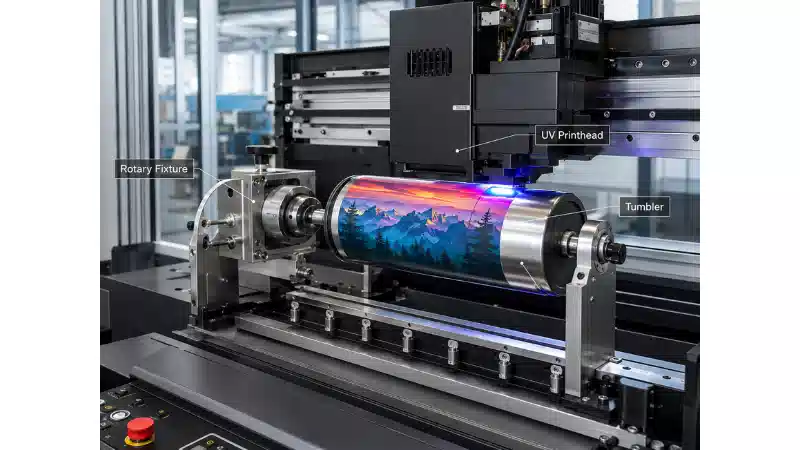
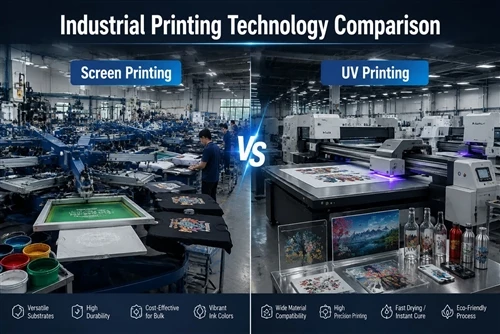
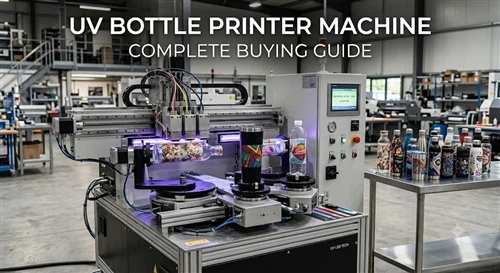
Flat signs, housings, and stable sheets are commonly evaluated on UV flatbed printers. Bottles and other round products require an appropriate cylindrical UV printer and a fixture that reproduces the intended rotation and product strain. Dacen's bottle printing samples show typical cylindrical applications.
Common UV Ink Selection Mistakes
| Mistake | Why It Fails | Better Approach |
|---|---|---|
| Matching ink only to whether the substrate feels hard or soft | The product may move during assembly, use, cutting, or forming. | Define the required behavior of the cured ink film. |
| Assuming hard ink is always more durable | Surface hardness does not guarantee resistance to bending or deformation. | Separate scratch, chemical, adhesion, and movement requirements. |
| Assuming flexible ink is automatically better | A softer film may not meet abrasion or surface-hardness requirements. | Compare both categories when the priorities conflict. |
| Believing primer guarantees adhesion | Primer cannot correct every contamination, coating, cure, or compatibility problem. | Compare a cleaned control with a verified treatment and inspect the failure interface. |
| Comparing stretch percentages without test conditions | Results may use different substrates, film builds, temperatures, and failure definitions. | Use figures only within the named manufacturer method and verify the product. |
| Testing only CMYK | The production job may fail in the primer, white, or varnish layer. | Test the complete production stack. |
| Approving the print by appearance alone | A vivid image does not prove adhesion, flexibility, abrasion, or chemical resistance. | Use documented product and end-use tests. |
FAQ
Q: Can flexible UV ink print on rigid materials?
A: Yes. Some flexible-application inks are designed for both flexible and selected rigid substrates. Printer compatibility, adhesion, surface resistance, and the final process must still be verified.
Q: Is rigid UV ink more durable than flexible UV ink?
A: Not in every way. Rigid ink may offer greater surface hardness or chemical resistance, while flexible ink may better resist cracking during movement and post-processing.
Q: Does flexible UV ink scratch more easily?
A: It can have lower surface hardness than a comparable rigid ink, but the result depends on the specific formulation, cure, surface, and film build. Test abrasion rather than assuming performance from the category name.
Q: Do I need primer with rigid or flexible UV ink?
A: Primer may be required with either category. The need depends on the exact surface and complete ink system, not only the flexibility of the color ink.
Q: Can I change from rigid ink to flexible ink in the same printer?
A: Only when the printer and ink suppliers support the conversion. Review the ink path, printhead, curing system, flushing method, profiles, warranty, and maintenance requirements before changing systems.
Q: How flexible should UV ink be?
A: It should tolerate the actual movement and post-processing required by the product. A routed board, squeeze bottle, folded film, soft phone case, and membrane switch need different film behavior.
Conclusion
The choice between rigid and flexible UV ink should begin with the behavior required from the cured print, not only the name of the substrate.
Use rigid ink as the first candidate when movement is minimal and surface hardness is the main requirement. Use flexible ink as the first candidate when the print must bend, squeeze, fold, cut, wrap, or form. In either case, confirm printer compatibility, qualify the exact product surface, test the complete ink stack, and reproduce the real production and end-use conditions.
Before converting an ink system or approving mass production, businesses can submit product details and samples for application evaluation. The printer, fixture, ink configuration, curing process, post-processing, and acceptance criteria should be reviewed as one production system.
Stable daily output also depends on maintaining the supported ink path. Follow a documented routine for UV printer printhead maintenance after the production process has been approved.