

A newer or faster printhead is not automatically a better choice for a cylindrical UV printer.
This matters when printing directly on bottles, tumblers, thermos cups, and other round objects. A printhead that performs well over a flat substrate may behave differently when its nozzles span a curved surface.
Can a G7 printhead be used on a cylindrical UV printer?
It depends on the printer design, product geometry, and the portion of the nozzle area used.
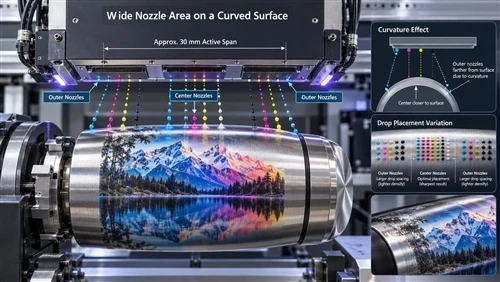
Our current thermos-cup configuration does not use the full G7 nozzle area. In the demonstration, the distance across the nozzle positions under discussion was close to 30 mm. When an area this wide sits above a cylindrical product, the surface beneath the nozzles is not all at the same height. That variation can affect ink-drop placement and the finished image.
The G7 is not a poor printhead. The issue is whether its nozzle arrangement suits a particular cylindrical printing system.
Why cylindrical printing differs from flatbed printing
A flat substrate presents a relatively even surface beneath the printhead. A cylinder does not.
Near the tangent point of a bottle or tumbler, the center of the product is closest to the printhead. The surface falls away from that tangent plane as the nozzle positions extend across the curve. A wider active nozzle area therefore creates more variation in the nozzle-to-surface relationship.

Near the tangent point of a bottle or tumbler, the center of the product is closest to the printhead. The surface falls away from that tangent plane as the nozzle positions extend across the curve. A wider active nozzle area therefore creates more variation in the nozzle-to-surface relationship.
Direct-to-shape inkjet printing has geometric demands that do not arise in the same way on a flat surface. Industrial inkjet literature describes curved-surface printing in terms of object shape, printhead arrangement, print path, and ink-drop laydown. DPI, firing frequency, and printhead generation alone are not enough to determine suitability.
How nozzle layout interacts with a curved surface
The width and arrangement of the active nozzle area were the main concerns in our test.
If only a narrow row of nozzles sits above a round bottle, the change in product height beneath that row may be relatively small. Using several rows at once spreads the active area across more of the cylinder. The outer nozzle positions then have a different geometric relationship to the surface than those near the center.
In our experience, a narrow effective nozzle area is easier to manage on a cylinder than a wide group of nozzle rows used simultaneously.
The useful comparison is not simply whether G7 is better than G6. The better question is whether the active nozzle layout matches the geometry and motion system of the cylindrical printer.
Why a wider print gap does not solve the whole problem
High-gap printing and printing across a curved cylindrical surface are related, but they are not the same engineering problem.
A printhead may control droplets across a larger nominal gap, while a cylinder presents continuously changing geometry across the active print region. The printer still has to control:
the active nozzles
the usable nozzle-to-surface distance
product diameter and rotation
printhead position
drop placement
synchronization between jetting and rotational movement.
Ricoh also treats curved-surface printing as a specialized technical problem. Its work on next-generation jetting systems distinguishes conventional printheads intended for short flight distances from technologies developed for much longer distances and curved surfaces.
Machine builders must evaluate the printhead together with the mechanical and control system.
How to evaluate a printhead for cylinder printing
Start with the product geometry rather than the printhead's headline specifications.
1. Check the product diameter
A small bottle curves more sharply across the same horizontal distance than a large cylinder. The usable nozzle arrangement may change with product size.
2. Determine the effective nozzle area
Do not rely only on the total nozzle count. Identify which rows will be active during cylindrical printing and measure their width across the curved direction.
3. Measure the print gap across the active area
The center and outer nozzle positions may sit at different effective distances from the product. Evaluate the whole active area with the actual cylinder diameter and printhead position.
4. Test drop placement
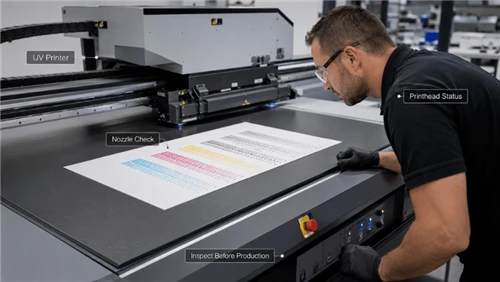
The ability to jet ink across a gap does not prove that the image will have acceptable sharpness, registration, and consistency. Run a print test on the actual product.
Treat printhead selection as a system decision
Current cylindrical UV printers show that several printhead strategies can work. Commercial systems use Ricoh G6 and Epson i1600 printheads, while industrial machines such as Dacen's F5 use Toshiba CF3 technology.
Choosing a printhead because it is newer, faster, or has stronger specifications on paper does not guarantee a better cylinder printer. For bottle and tumbler printing, the printhead must work with the product diameter, rotary mechanism, usable print gap, nozzle layout, ink system, and control strategy.
That is why we would not use the complete G7 nozzle area in our current cylindrical configuration. A narrower active area, or a printhead architecture designed around the specific cylinder printer, may be more practical.
5. Evaluate the complete system
The printhead is one part of the printer. Rotary positioning, fixture accuracy, motion control, RIP and waveform settings, ink properties, curing, and product geometry all affect the result.