

Define the relief before comparing machines
Selecting a cylindrical flowerpot relief printing machine takes more work than choosing a conventional round screen printer. The first decision is whether the design physically displaces the clay or sits above the existing surface.
That distinction affects the printing technology, fixture design, curing or firing route, possible texture, and level of automation. A machine designed for an unfired terracotta pot may be entirely unsuitable for an already glazed ceramic planter.
For flowerpot manufacturers, a cylindrical UV printer belongs to the surface decoration side of this decision. It is most relevant when a formed bisque or glazed flowerpot needs a printed layer, while green or leather-hard clay that requires deep physical relief is usually better handled by mechanical embossing. Whether UV printing is suitable still depends on the pot's diameter and taper, fixture accuracy, ink adhesion, curing method, and whether the decorated pot will later enter a kiln.
Machine types for cylindrical relief work
Four machine architectures are worth evaluating.
| Machine type | Best substrate | Relief method | Typical application |
|---|---|---|---|
| Rotary emboss or deboss press | Green or leather-hard clay | Mechanically displaces clay | Deep geometric texture |
| Cylindrical thick-film screen printer | Bisque, terracotta, or glazed ceramic | Deposits high viscosity material | Raised logos and decorative bands |
| Chuck-driven servo rotary printer | Bisque or glazed pots | Controlled rotation with a screen or stencil head | Accurate 360 degree or multi-pass work |
| Rotary or indexing hybrid line | Any of the above, depending on the print head | Multiple printing, drying, and handling stations | Medium and high volume production |
Rotary embossing
For genuinely deep relief, embossing the clay before final firing is usually the most practical method. A patterned roller or die contacts the green or leather-hard pot as the pot rotates.
This process can produce much deeper texture than ordinary ink deposition. It also demands close control of moisture and wall thickness. Too much pressure can deform the pot, affect its roundness, or cause cracks while it dries. Rotary embossing generally suits terracotta and other unfired ceramic bodies better than fired glazed ceramics.
Thick-film cylindrical screen printing
When the relief needs to sit on top of the surface, thick-film screen printing is often a better fit. A heavy stencil and high viscosity ceramic material deposit substantially more material than a conventional screen process.
Ceramic relief printing has used stencils about 0.015 to 0.060 inch thick, with even thicker stencils in special cases. The process works well for raised lettering, textured bands, logos, dots, and repeating motifs.
Specify the usable process window
A purchasing specification should state:
- Minimum and maximum pot diameter
- Maximum print height
- Required circumferential coverage
- Target relief height after drying and firing
- Number of passes and colors
- Pot runout and taper
- Required registration accuracy
Do not assume that the largest advertised product size is also the largest usable relief printing area.
Chuck-driven and rotary indexing machines
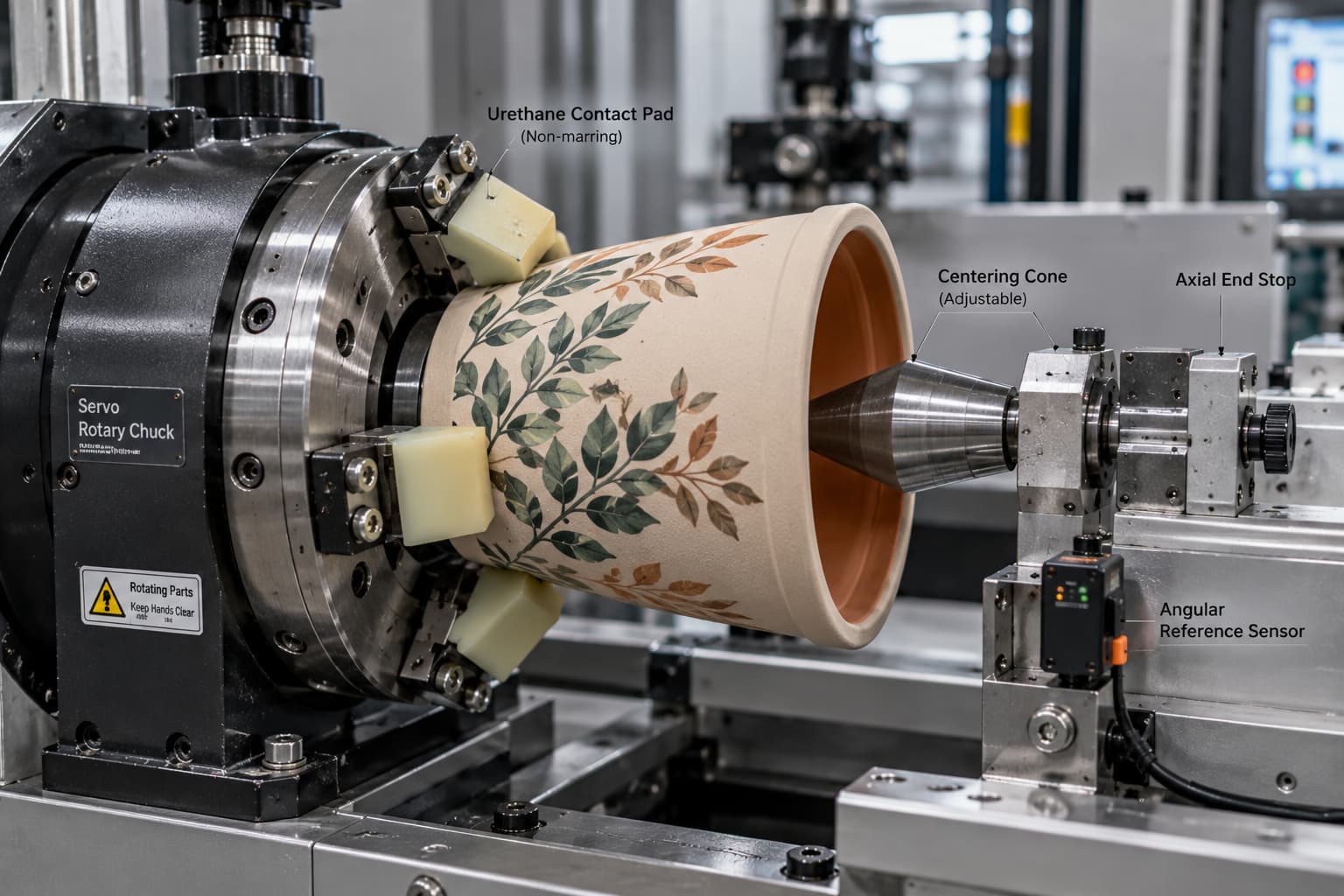
A chuck-driven machine grips or centers the pot and rotates it in synchronization with the print head. Because the print motion is referenced directly to pot rotation, this arrangement is useful for 360 degree designs.
For higher output, the chuck can be part of a rotary indexing table with stations for loading, cleaning, surface treatment, printing, flash drying, inspection, and unloading. Commercial cylindrical platforms use this kind of architecture with multi-station indexers and servo-controlled re-registration.
Some high speed systems for smaller cylindrical packaging advertise rates of up to 60 parts per minute. That figure should not be applied directly to large, heavy ceramic flowerpots. Require a timed sample run with the largest and heaviest pot you intend to print.
Production capacity and ROI
The fastest print head does not automatically produce the fastest line. Loading, centering, flash drying, extra passes, unloading, and final curing or firing may set the true pace. Large ceramic pots also need more careful handling than lightweight bottles.
The ranges below are planning assumptions, not guaranteed machine specifications.
| Production level | Planning output | Typical configuration |
|---|---|---|
| Low volume | 20 to 60 pots/hour | Manual loading and semi-automatic printing |
| Medium volume | 80 to 200 pots/hour | Servo chuck, assisted loading, and inline curing |
| High volume | 250 to 600+ pots/hour | Automatic feeding or indexing with multiple stations |
A high volume line may use robot loading, automatic centering, vision registration, a rotary indexer, several printing stations, UV or thermal flash curing, and automatic discharge.
Calculate payback from good pots
The following one-shift example shows how the calculation can be structured.
| Scenario | Good output/year | Installed investment | Added margin/pot | Annual operating cost | Approx. payback |
|---|---|---|---|---|---|
| Low volume | 70,000 | $30,000 | $0.80 | $32,000 | 1.25 years |
| Medium volume | 245,000 | $120,000 | $0.70 | $70,000 | 1.18 years |
| High volume | 700,000 | $320,000 | $0.60 | $165,000 | 1.25 years |
These values are examples only. Replace them with your labor rate, selling price premium, scrap rate, consumable costs, kiln cost, maintenance, utilities, and production schedule.
Adjust output for OEE
Return calculations should use OEE-adjusted output rather than the machine's theoretical speed.
A 200-pot/hour machine running at 85% availability, 90% performance, and 97% quality produces about:
The adjusted figure is far more useful for an ROI model.
Print materials, curing, and substrate fit
The condition of the pot determines which printing chemistry can be used.
Uncoated terracotta
Porous terracotta can absorb liquid binders quickly. Too much absorption may leave ragged edges or weak raised structures.Possible remedies include controlling surface moisture, applying a compatible primer or sealer, increasing the body of the paste, printing on bisque instead of completely raw clay, and testing shrinkage through the final firing cycle.
Glazed ceramic
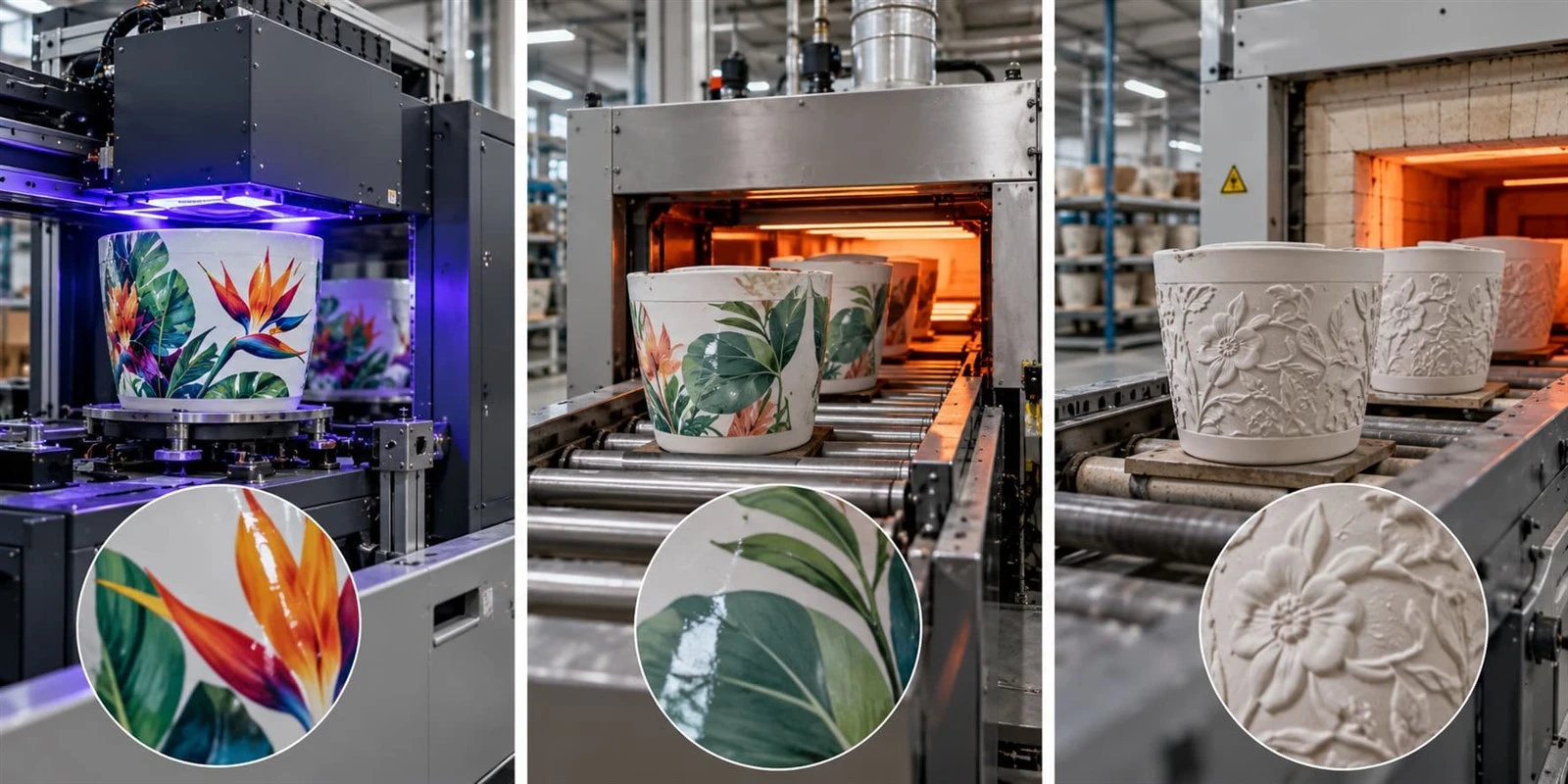
A glazed pot has a smooth, nonporous surface. Conventional organic inks may be cured with UV or heat, but they should not be assumed to survive a ceramic kiln.
If the decoration must become part of the fired surface, use a ceramic system made with suitable pigments, frits, stains, or other firing compatible materials. Ceramic decoration relies on inorganic pigments designed to survive firing, not ordinary commercial printing ink.
| Material system | Cure route | Main advantage | Main concern |
|---|---|---|---|
| UV organic ink | UV curing | Fast production | Usually unsuitable for later kiln firing |
| Heat-curing coating | Oven or IR | Good industrial adhesion | Temperature limits of the substrate and coating |
| Ceramic glaze or paste | Kiln firing | Permanent ceramic decoration | Color and relief can change during firing |
Kiln firing can change color, gloss, dimensions, and texture. Frit flow may soften relief edges, while pigment chemistry and the firing atmosphere can shift the final color.
Test the full process before acceptance
Produce at least three conditions during the machine acceptance trial:
- The minimum intended relief deposit.
- The nominal production setting.
- The maximum practical relief deposit.
Run every sample through the complete production route, including drying, glaze application where applicable, and final firing. Evaluate relief height before and after firing, adhesion, edge definition, pinholes or blistering, glaze crawling, cracking or delamination, color shift, abrasion resistance, and outdoor or water resistance where required.
For multicolor work, inspect registration after firing as well as immediately after printing.
Registration, fixturing, and pot preparation
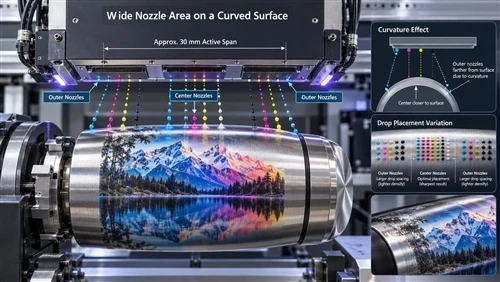
Round flowerpots create three main registration problems: radial runout, axial position variation, and taper. A fixture that handles precisely molded bottles may perform poorly with ceramic pots because fired ceramics often have more dimensional variation.
Common fixture options include mechanical expanding chucks, centering cones, adjustable mandrels, soft urethane jaws, pneumatic expanding fixtures, vacuum-assisted supports, and quick-change dedicated nests.
Avoid applying excessive clamping force to thin ceramic walls. Soft contact surfaces and controlled pneumatic pressure can reduce cracks and cosmetic damage.
Set registration targets that match the pots
Machine repeatability cannot correct excessive runout in the pots. Measure the dimensional variation of at least 30 to 50 production pots before completing the fixture design.
A reliable fixture must control both:
- Z-axis position: how far the pot enters the chuck.
- Angular zero position: where the design starts around the circumference.
For multiple passes, use a mechanical key, molded feature, printed registration mark, or vision sensor to restore the angular position.
Typical production routes
For bisque or glazed pots:
For greenware:
Remove surface dust, fingerprints, release agents, and glaze contamination before decoration.
Ownership cost, supplier support, and safety
The lowest machine quotation is rarely the least expensive system over five years. Ask each supplier for a complete list of consumables and spare parts, including screens and stencils, squeegees, chuck pads and seals, pneumatic cylinders and valves, bearings, servo couplings, sensors, UV lamps or LED modules, filters, and fixture wear parts.
Do not accept an unsupported claim such as "high MTBF." Ask for failure data from the installed base and define measurable FAT and SAT acceptance criteria. A qualification run might require the line to maintain an agreed good-part rate and at least 90% operational availability for a defined period.
Questions for supplier support
U.S. buyers should verify:
- Warranty length and exclusions
- U.S. or remote technical support
- Spare parts stocking location
- Response time for critical failures
- English electrical drawings and manuals
- PLC and HMI backup files
- Operator and maintenance training
- FAT before shipment
- SAT after installation
- North American voltage and frequency compatibility
- Required compressed air supply
Some imported cylindrical printing machines are available in configurations such as 380 or 480 V three-phase power at 50 or 60 Hz. Confirm the electrical configuration before shipment instead of trying to correct it after the machine arrives.
Calculate the full landed cost as well. Include crating, ocean freight, insurance, customs duties, broker charges, inland transportation, rigging, installation, and technician travel.
U.S. safety and environmental planning
When inks or cleaners contain hazardous chemicals, employers may have Hazard Communication duties related to labels, safety data sheets, and employee training. Solvent based printing can also release VOCs or hazardous air pollutants, especially during printing and drying.
OSHA silica requirements may apply when dry clay, ceramic dust, sanding, or grinding exposes workers to respirable crystalline silica. Kilns add heat, combustion, exhaust, and fire protection concerns.
EPA also identifies emissions associated with ceramic manufacturing and kiln processes. The federal, state, and local rules that apply to a flowerpot facility depend on its materials, production volume, and location.
Plan ventilation, guarding, emergency stops, electrical isolation, compressed air isolation, hot surface protection, kiln exhaust, and safe material storage before installation.
Require a sample test before purchase
Do not select a cylindrical flowerpot relief printing machine from a brochure alone. Send each potential supplier real production samples and request a documented pilot run.
Information to send with the pots
- Pot material
- Minimum and maximum diameter
- Height and weight
- Wall thickness and taper
- Green, bisque, or glazed condition
- Glaze type
- Required artwork
- Number of colors
- Target relief height
- Required pots per hour
- Intended curing or firing schedule
Evidence to request
Ask for printed samples, measured cycle times, registration data, consumable use, the recommended machine configuration, and a five-year estimate of operating cost.
Useful website actions for this type of project include:
- Request a Sample Test
- Download the Flowerpot Printing Machine Buying Checklist
- Calculate Your ROI
- Request a Factory Assessment
For a U.S. project, the quotation should also identify freight, installation, commissioning, operator training, spare parts support, and local or remote service options.
Where a UV printer fits in flowerpot production
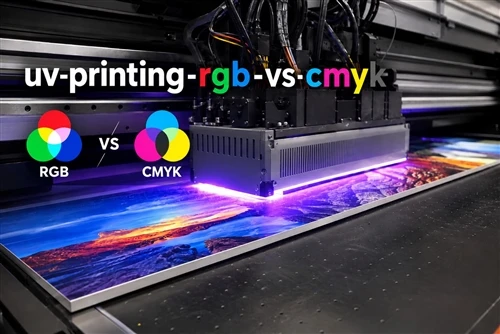
A cylindrical UV printer can be a practical flowerpot decoration machine when the pot is already formed and the required effect comes from material printed onto its surface. The supplier still needs to prove that the machine can center a tapered flowerpot, hold it without cracking or marking the wall, maintain registration around the circumference, and cure the selected ink on the actual pot surface.
Do not treat a UV printer designed for bottles as production ready for flowerpots. Qualify it with the real flowerpot material, size range, weight, glaze, artwork, and target output. If the decoration must survive kiln firing or needs relief deeper than a printed layer can provide, compare the UV printing route directly with firing-compatible ceramic paste or pre-firing mechanical embossing before choosing the machine.
Frequently asked questions
Which machine works best for terracotta and glazed ceramic flowerpots?
For green or leather-hard terracotta, mechanical rotary embossing is generally the best choice when the design needs deep texture. For bisque or glazed ceramic, a chuck-driven thick-film screen or ceramic paste printing system is usually more suitable because it builds the relief on the surface instead of deforming the pot.
How many pots per hour can semi-automatic and automatic systems produce?
For early budgeting, a manually loaded semi-automatic line may run at about 20 to 60 pots per hour. More automated servo or indexing systems may target 80 to 200 pots per hour or more. Fully automatic systems can be considerably faster, but actual output depends on pot size, loading, the number of passes, drying, curing, and firing. Require a timed trial with your pots.
Which inks or glazes can survive kiln firing?
Use ceramic materials formulated for the required firing cycle, such as compatible stains, frit-containing pastes, or ceramic decoration systems. Do not assume that ordinary UV or organic printing ink will survive kiln temperatures. Test color, texture, adhesion, and relief after the complete firing cycle.
How is accurate multicolor registration achieved on a round pot?
The fixture must control axial position, centerline, radial runout, and angular zero. Servo-controlled rotation, positive stops, registration marks, or vision systems can then synchronize later passes. A target around ±0.3 to 0.5 mm is useful for many quality flowerpot applications, as long as the pots are dimensionally consistent.
Which maintenance and warranty terms should a buyer request?
Request a preventive maintenance schedule, a complete spare parts list, recommended stock for one or two years, warranty exclusions, response time commitments, PLC backups, electrical drawings, operator training, FAT, SAT, and clearly defined production acceptance criteria.
What workshop and kiln requirements should be planned in the U.S.?
Review the electrical supply, compressed air, ventilation, machine guarding, chemical handling, kiln exhaust, heat management, fire protection, silica exposure where relevant, and all applicable OSHA, EPA, state, and local requirements. The exact requirements vary with the chemistry, production volume, and location.
Should sample testing be required before purchase?
Yes. A sample or pilot run is one of the most useful parts of machine qualification. Require the supplier to use the actual pot, glaze, artwork, relief target, and curing or firing route. The report should include cycle time, reject rate, registration, final relief height, adhesion, consumable use, and expected production cost for each good pot.